Guild members will no doubt be saddened to hear of the passing earlier this month of renowned motoring and motorsports journalist and author Eric Dymock. Ray Hutton has kindly penned the following tribute to Eric.
“On a spring day in 1962, Jackie Stewart had arranged a private track session at Oulton Park. He recalls that he drove down from Scotland with three friends – a local golf champion, a motor trader and ‘Scotland’s newest motoring journalist’. On that day, Jackie decided to become a professional racing driver and the journalist was set to launch a career that showed him to be among the very best in his profession. His name was Eric Dymock.
Eric died on 18th January at the age of 91. It is fitting that only a year ago, his own publishing company should produce a new edition of the book that he co-wrote in 1970: Jackie Stewart World Champion. Eric’s journalism started with The Hamilton Advertiser – the Jaguar E-Type was one of his first road tests – but not long after the Oulton track day he moved to London to join The Motor.
After three years on the road test staff, with weekends assisting the sports department, Eric took the bold step (for the 1960s) of leaving to become freelance. He travelled around Europe with the Grand Prix circus, reporting for The Guardian and others. His friendship with fellow Scots Jim Clark and Jackie Stewart gave him a head start with the racing community and his stories benefitted from a greater insight than his Fleet Street rivals.
In the following years Eric’s portfolio widened, with a general motoring column in The Observerand, subsequently, News International’s Sunday newspapers. He wrote scripts for TV motoring programmes from Thames TV, Australian Broadcasting and the BBC, including the first version of Top Gear, and was a regular contributor to Going Places on BBC Radio 4.
While motoring editor of The Sunday Times, he revived and chaired the Fleet Street Motoring Group, an exclusive luncheon club which hosted captains of industry and the movers and shakers of the motoring scene.
Books of motoring history were a sideline at this busy time but in 1990, Eric and his wife Ruth established Dove Publishing to produce Eric Dymock Motor Books, a series of comprehensive marque histories, and other titles. He was awarded the Guild’s Montagu of Beaulieu Trophy in 1997 for Saab – Half a Century of Achievement and in 2008 for The Complete Bentley.
Eric was particularly proud of Jim Clark, a biographical tribute published in 1997, so it seems appropriate that, in 2004, he was awarded the Jim Clark Memorial Award by the Association of Scottish Motoring Writers honouring Scots who have achieved excellence in the field of motoring.
Eric had a healthy scepticism of politicians and environmentalists and was never afraid to speak his mind. Always well informed, his writing combined the clarity of a good journalist with the friendly conversation of a true enthusiast.
He was a precise and skilful driver, fast whenever the opportunity arose, and the perfect companion for those long-distance test drives that the more adventurous manufacturers staged in the 1980s and 1990s. I know, because he and I chatted and laughed our way to the ends of the earth – well actually, to the Arctic North Cape and across deserts in North Africa. Good times with one of the finest motoring writers of the era.”
Eric’s funeral will be geld on Thursday 26th February at Lea Fields Crematorium, Gainsborough Road, Gainsborough, Lincs DN21 5PL, starting at 12.30. The service will be followed by a gathering at The White Swan, Newark Road, Torksey Lock, Lincoln LN1 2EJ. Eric’s wife Ruth says that all are welcome – she can be contacted here.
We were very saddened to hear of the passing of Guild member and renowned motoring artist Michael Turner earlier this month at the age of 91. We are grateful to fellow member Chris Mann for the following tribute.
Michael Turner was one of the Guild’s oldest and longest-serving active members, and also a founder member of The Guild of Aviation Artists, later serving as both chairman and president. He was an honorary fellow of the Guild of Motoring Artists.
Born on 14th March 1934 he spent his formative years in the London suburb of Harrow. Obsessed from an early age with all things aeronautical, he later extended his interest into cars and motor sport following a family holiday to the Isle of Man in 1947 where he saw his first motor race, the British Empire Trophy.
After art college and National Service with the Royal Electrical and Mechanical Engineers he was taken on as an illustrator by a London-based advertising agency. Michael was already an enthusiastic motorist, his first car being an Austin Seven special followed by a somewhat more sporty MG F-Type Magna.
As his finances improved Michael decided that he needed something faster and, combing through the then ubiquitous small ads of Motor Sport magazine, he came across an advertisement for an SS100 Jaguar. This he went to see “in a dusty mews lock-up in Bayswater”. A price of £350 was agreed and a £100 deposit paid, on the basis that the so-called dealer would rebuild the gearbox prior to Michael collecting the car the following week.
Unfortunately when Michael returned to pick up the SS100 both the dealer, and Michael’s money, had disappeared. A distraught Michael contacted the police who somehow managed to locate the car’s owner in Cardiff who generously agreed to sell the car to Michael for £250, the original price less the missing deposit, the only downside for Michael being the un-rebuilt gearbox.
Michael used the SS100 (DTF 28) as his daily transport for the next few years, clocking up many miles and nearly as many adventures (including being rammed by a car driven by an American serviceman unfamiliar with driving on the left) “I was ejected from the driver’s door into the road and the rear wheel went over my foot”.
Michael also carried out his courting in the then cycle-winged Jaguar but much to his chagrin “girlfriends invariably took the mickey out of my SS with such quips as ‘is the bonnet strap there to keep the engine in’ or complaining about the effect of the wind in their hair”.
However one girl, Helen, seemed to genuinely enjoy going out in the SS100 and one day early in their courtship when the couple were driving from Wendover to Aylesbury, Michael decided to see whether the car would do the 100mph claimed. “I put my foot down and managed to get to an indicated 105mph when a line of stationary traffic loomed up ahead. After some scary moments I managed to pull up with about three car lengths to spare. Amazingly Helen remained calm and took it all for granted. I know then that I had found the right girl for me.”
As a young man, Michael harboured ambitions to go racing himself and, as the SS had previously been raced with some success, the temptation was strong. A trip to Silverstone, though, where he witnessed a massive accident at Becketts Corner caused Michael to rethink. “The SS was my daily driver so I couldn’t afford to risk damaging it. I loved driving but restricted myself to driving tests, gymkhanas, karting and the like.”
Meantime, despite having established himself as a successful illustrator in the world of advertising and publicity Michael was feeling increasingly constrained by his job so, in 1957, he took the plunge and went freelance, foregoing a regular salary cheque for the uncertain life of a self-employed artist.
Tight finances meant that the SS100 continued to provide his daily transport, regularly carrying artwork to London studios. On one occasion Michael recalled “a bus driver leaned from his cab, pointed to the SS and said ‘that’ll do half an hour in 20 minutes, mate”.
Michael and Helen married in 1960, going on to have three children, Graham, Alison and Suzie, so more practical everyday transport was now required, resulting in the purchase of a new Austin A40 Farina. The SS100 was retained however, despite a number of tempting offers including one from Jaguar’s PR director Andrew Whyte who told Michael that they were looking for an SS100 to add to their collection and asked if he would be willing to swap his car for a brand-new E-Type. “I thought long and hard and although I’d tried E-Types and loved them I couldn’t bring myself to part with my SS.”
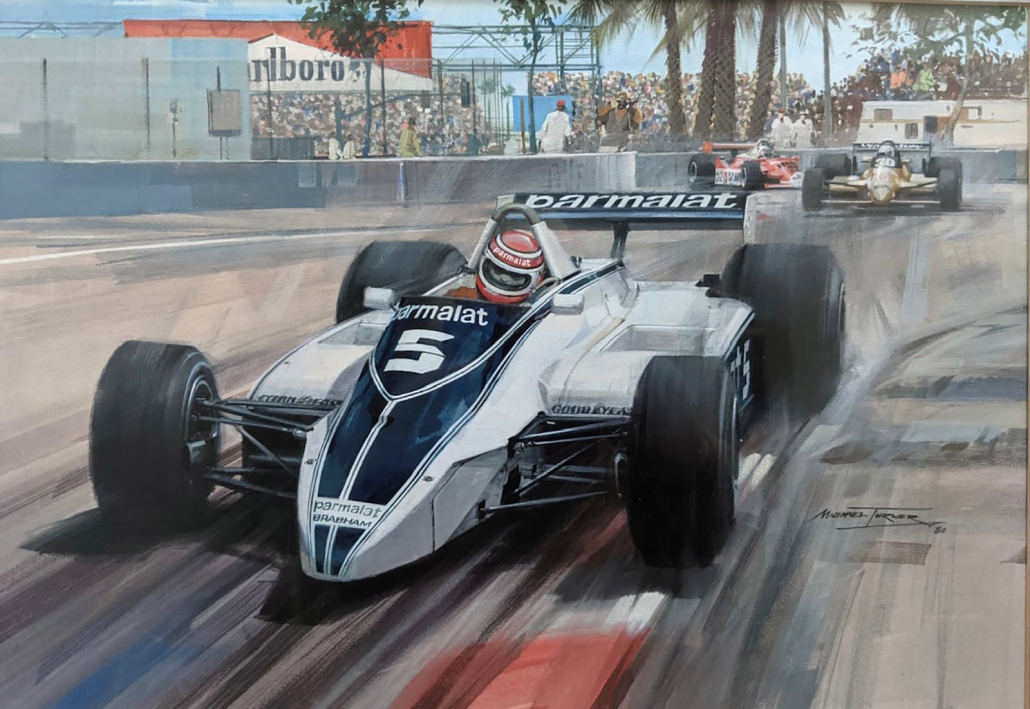
Michael and Helen established their own business, Studio 88, in 1963 in order to promote Michael’s artistic endeavours. By this time he had already built up a reputation as a highly-successful aviation and motoring artist, as well as being the go-to man for publicity posters for top-line motor racing events. By now, his paintings were gracing magazine covers, book jackets and the walls of the legendary Steering Wheel Club in Mayfair, then the mecca of the great and the good (and not so good) of motor racing.
As a result, Michael established close friendships with many of the top drivers and team owners of the time, including such legends as Stirling Moss, Jim Clark, Graham Hill, John Surtees and Jackie Stewart. Indeed, by the mid-1960s he had become as celebrated in his field as they in theirs.
As Michael later recalled “with fewer races on the Grand Prix calendar… drivers often had the time to spend the day after a Grand Prix relaxing and at Monaco, Cap Ferrat was a favoured secluded spot. After the 1965 event (for which Michael had produced the publicity maquette) I, along with Graham and Bette Hill, Jo Bonnier and Bruce and Pat McLaren were enjoying sunbathing and swimming from the stony beach.”
A couple of years earlier Bruce had set up his eponymous race car manufacturing company, calling upon Michael to design the fledgling manufacturer’s logo which, said Michael “was unkindly described by one journalist as a Kiwi being run over by a racing car”.
In the previous year, McLaren had produced its first Group 7 sports car, the M1A and “during the course of the morning at Cap Ferrat Bruce asked me if I would design a body for its successor (the M1B) due for completion in eight weeks time. On our return home Bruce provided me with a set of engineering blueprints… he approved a sketched proposal and, not being a stylist, I set to work to produce the necessary dimensional proportions on large sheets of graph paper spread on the studio floor.
“Tyler Alexander supervised the transposition of my drawings into metal and the semi-painted prototype was wheeled out of the Colnbrook factory the morning that it was to be airfreighted across the Atlantic for the opening race. Apart from the simplification or elimination of some of my styling embellishments… and the enlargement of some cooling vents for practical operational reasons, the result was surprisingly similar to the concept.”*
Promoting Michael’s work, along with marketing prints of many of his motor racing and aircraft paintings as well as the hugely popular F1 Christmas card sets, Studio 88 thrived. Some time later Michael’s son Graham, himself an artist of considerable repute, came on board and when Michael and Helen decided to take a step back, Graham and his wife Anita took over the business which they still run successfully to this day.
I got to know Michael about 25 years ago when my wife and I first went on one of the Guild’s then annual (and now much missed) European Classic Tours. He and Helen were regulars in their E-Type (Michael eventually succumbed to the lure of the E-Type but never parted from his beloved SS100) and proved great company. Both had a real gift for friendship, making everyone they spent time with feel special.
I later commissioned various paintings from Michael and these were invariably delivered on time and on budget, while Michael would frequently call up with an idea he had had for enhancing the image, even when it involved considerable additional work for him.
A few years ago we were both attending the Guild AGM at Bicester Heritage when his (relatively) modern MG ZT estate car failed to start after the meeting. Somehow the octogenarian Michael squeezed his lanky frame into my one-and-a-half seater 1936 Triumph Southern Cross race car, which had no doors and only minimal protection from the elements, and we headed back to Michael’s home in Chartridge, a journey which he claimed to have thoroughly enjoyed!
Michael’s aircraft studies were highly prized and he received regular commissions from the Royal Air Force. Some years ago, on a trip with Michael to a black-tie event at the RAF Club in Piccadilly I was amazed to see the sheer volume of wonderful Michael Turner paintings on the walls of this august establishment. A keen pilot, Michael flew his own De Havilland Chipmunk well into his eighties, only selling the plane when he lost his hangar space at RAF Halton.
Helen was a keen gardener who designed and laid out the beautiful gardens at their home of many years, Five Acres in Chartridge. She was enthusiastically aided and abetted in this by Michael who did much of the hard landscaping and, even up until a few weeks before his death, he could be found on the ride-on mower keeping the grass down.
After Helen’s passing, a loss which devastated Michael but which he bore with remarkable stoicism, we would take off on regular days out, visiting motor and aviation museums and assorted other venues we thought might be fun. Michael was always up for an adventure and I remember him being particularly taken with the Stanley Spence Gallery in Cookham and the Sir Henry Royce Foundation Archive in Paulerspury where we went only last summer, along with friend and fellow artist Dexter Brown, the visit followed by a much-enjoyed fry-up at the super Sausage Café on the A5!
Wherever we went, Michael would always have his digital camera at hand, snapping away at anything that took his interest or which he felt might be a useful reference to his next painting. Many a time he would ask me to stop at the roadside so he could take a photograph of a particularly interesting cloud formation that he felt might be worthy of painting.
Despite the loss of Helen and the medical challenges he faced in his latter years, Michael was unfailingly cheerful and good humoured, a gentleman in every sense and a great loss to his friends, his colleagues and, of course his family.
Following his father’s death Graham Turner said; “We will of course endeavour to keep his work available and his legacy alive in the years to come. That word ‘legacy’ keeps recurring in the incredible amount of wonderful messages and comments about my father and is something I’m very conscious of as I reflect on his life.”
Michael Turner was a one-off, a great artist and an even greater human being. He will be much missed and long remembered.
*McLaren quotes taken from The Motorsport Art of Michael Turner. Photos by Chris Mann
We are sad to report the death at the age of 85 of Michael Bowler, magazine journalist and editor, prominent historic racer and engineering chief of Aston Martin.
Guild vice-president Ray Hutton was Michael’s friend and one-time rival (in print, not on track) and provides the following appreciation:
Michael’s early life sounds like something from Chariots of Fire. In his schooldays, his father, Harry Bowler, who had raced a Bentley at Brooklands, fired his enthusiasm for cars and took him to Vintage Sports Car Club events. Then, as a dashing, handsome young man, he went to Pembroke College, Cambridge to read mechanical sciences, gained a reputation as an all-round sportsman, was awarded a rackets half-blue and became a Royal (Real) tennis champion. At the same time he won VSCC races driving a 1925 Frazer Nash and was a part of a team from the Cambridge University Car Club to set some long distance speed records at Monza in an Austin A35.
Michael had never intended to be a journalist. A career in engineering beckoned – after graduation he had joined English Electric in Rugby – but cars and motor racing were his real interest and in 1963, through family friends Dick Benstead-Smith and Harold Nockolds, editor and publisher of The Motor, he was offered a job as road tester. Modern cars became his business, old cars his hobby.
Michael acquired a famous 1955 Frazer Nash Sebring with which he had several seasons of success in historic racing, while he also owned and raced a rare 1940 Mille Miglia BMW 328. At Motor, as it was from 1964, his natural driving skill was appreciated, even if was sometimes exercised rather too enthusiastically; hence the soubriquet ‘Roller Bowler’.
In 1971, Michael became Sports Editor of Motor and enjoyed following the Grand Prix circus for a couple of years but during this time he fell into discussion with Lionel Burrell about the possibility of a magazine about cars that were 25-40 years old and were not covered by existing titles. Publisher IPC took up their idea and Classic Car was born. The magazine is credited with starting a new movement in the car world and the Guild recognised this by awarding the Pemberton Trophy to Michael and Lionel in 1977.
As the founding Editor, Michael stayed with Classic Car for eight years during which time historic racing started to take off internationally. He became involved with the RAC and FIA Historic Commissions and for his own racing exchanged the Frazer Nash for a 1959 Lister-Jaguar.
He enjoyed great success with the Cambridge-blue Lister and was to win the FIA Coupe d’Europe in 1979, 1980 and 1981. As far as I can establish, Michael was the first and only Guild member to win an FIA international racing championship. He was awarded the Guild’s Rootes Gold Cup (predecessor of the Prodrive Motorsport Cup) in 1979.
In 1981, Michael left journalism, and the Guild, to become Victor Gauntlett’s right-hand man. The founder of Pace Petroleum was soon to take control of Aston Martin and in due course Michael was appointed Engineering Director of the company. Then, as now, there were frequent changes in Aston Martin management and Michael found himself in Milan as Managing Director of Zagato, of which Aston Martin then owned 50 per cent.
Ford took over Aston Martin in 1987 and Gauntlett resigned in 1991 by which time Michael had joined Yamaha’s fledgling car operation in Britain. He was one of the very few to drive the F1-engined OX-99 supercar. No customer cars were ever built, so Michael left and returned to journalism.
As a freelance he wrote a number of books and his career turned full circle: he was appointed Editor of The Automobile, which brought him back into contact with many of the cars that were classics in the 1970s.
Golf was Michael’s main activity in retirement and it was a cruel twist of fate that he was unable to play after a long illness that resulted in a leg amputation. He continued to attend events, including the Guild AGM, in a wheelchair (carbon fibre, of course), tended by his loving wife Jane. The Guild sends sincere condolences to Jane and their three sons Simon, James and Andrew.
Michael Bowler’s funeral will be held on Friday 5 September at 12.15 at the Hampden Chapel, Chilterns Crematorium, Whielden Lane, Amersham HP7 0ND with a gathering afterwards at Chorleywood Golf Club, Common Lane, Chorleywood WD3 5LN. All Guild members are welcome.
Members will be aware from the most recent edition of News Briefs that we lost our member Anders Ditlev Clausager on 27th July, following a battle with cancer.
A journalist deeply involved in so many aspects of motoring history, Anders was a Trustee of publishing charity the Michael Sedgwick Memorial Trust (MSMT) since 2010 and Vice Chairman from 2022 until ill-health forced him to step down in June 2025. The Guild is grateful to the MSMT for the information that follows in this tribute.
Anders had been Secretary of The Society of Automotive Historians in Britain (SAHB) since 2009, a member of the Advisory Council of the National Motor Museum at Beaulieu and organised the regular European Conference of Motoring History. For many years he was Historian and Registrar to the Wolseley Register and compiled the Register’s List of Recorded Vehicles in 1987.
Anders was born in Denmark in 1949 and the seeds of his anglophile tendencies may have been sown by the acquisition of a Wolseley 4/44 while still a student. His first degree gained from 1970 to 1974 was at the School of Architecture in Aarhus. He came to London in 1974 to study automotive design at the Royal College of Art and left with a master’s degree in 1976.
His first work was on the second-generation Volkswagen Polo but by 1978 he had returned to England and was working for British Leyland. In 1979 he became archivist to BL Heritage, which later became the British Motor Industry Heritage Trust, leaving for the Jaguar Daimler Heritage Trust in 2000.
At this time he completed a master’s degree in history at the University of Warwick and remained with the JDHT until he retired in 2012. He twice received the Bradley Distinguished Service Award from the American Society of Automotive Historians for his work at the BMIHT and the JDHT.
Anders authored or co-authored 24 books, mainly on British cars but including titles on Porsche and Volvo, as well as many magazine articles for The Automobile, Aspects of Motoring History (published by the SAHB) and others in the UK, USA and Germany.
In addition he translated books from German to English, edited other books and compiled catalogues. In 2017 his magnum opus, Wolseley – A Very British Car won the Michael Sedgwick Award from the SAHB, the Cugnot award from the American Society of Automotive Historians and the Mercedes-Benz Montagu Award from The Guild of Motoring Writers.
Diagnosed with cancer in July 2023, Anders continued to play an active part and contribute to all of the automotive history organisations that he was involved with as well as he could. He was delighted to complete an article on the first known car produced in Denmark, the Hammel, which appeared in the June 2025 issue of The Automobile. In his final months he also completed Profile books for the Wolseley Register on the 4/44 and 15/50. A final book BMC Farina Cars In Detail will be published this autumn by Herridge & Sons which will be supported by the MSMT.
Anders’ contributions will be sorely missed in all the fields he participated in. His dry wit, personable manner and extensive knowledge made him a valuable member of any meeting or conversation. He is survived by his husband David with whom he lived in Birmingham, near to the main sites of the British motoring industry.
Several Guild members have shared their memories of Anders, vice-president Ray Hutton summing up the thoughts of many, describing him as “one of the foremost motoring historians,” while Guy Loveridge described Anders as “one of the greatest of motoring historians and a leading light of the pan global historic motoring and preservation community”.
A ‘Celebration of Life’ will be held for Anders on Thursday 21st August, from 12.00 midday in the North Chapel at Oakley Wood Crematorium, Bishop’s Tachbrook, Leamington Spa CV33 9QP and afterwards at the British Motor Museum, Banbury Road, Gaydon, Warwickshire CV35 0BJ. It is planned that the Oakley Wood ceremony will be webcast for those overseas and otherwise unable to attend.
Organisers are keen to focus on a celebration and have requested no black armbands or flowers. For those who wish to give a donation in memory of Anders, he was keen to support the Birmingham Hospice, Selly Park that cared so wonderfully for him in his final illness. There will be a collection box at Oakley Wood, or alternatively donations may be made directly to Birmingham Hospice.
It is with much sadness that we have to report the untimely death of Gordon Bruce, one of the best-known figures in motor industry consultancy and communications services, and among Guild members, motoring journalists and the motor racing community as former Ford PR manager, “Motor” magazine road test editor and well-regarded former racing driver. Gordon, who was 76, died of a heart attack during a gym session near his Buckinghamshire home just a few days before Christmas.
To his devoted wife, Marilyn, to children Alastair and Becky and to his several grandchildren, the Guild extends its most sincere condolences.
Gordon waved goodbye to his former careers as PR manager at Ford and Motor magazine’s road test editor in 1982 to establish Gordon Bruce Associates. It evolved very quickly, becoming a team of around 20 motor industry communications specialists and one of Europe’s leading consultancies in its field. More than two decades later, in 2005, Gordon changed direction somewhat, hiving off part of the business to concentrate on becoming a boutique consultancy, but still serving the motor, motorsport, motorcycle and aviation sectors.
Although officially retired, right up to his death Gordon was still closely associated with industry colleagues, his global network of motoring friends and – not least – his many companions in the Guild. “It seems hard to think that it was only a few weeks ago that Gordon and that gorgeous pale blue E-Type of his were belting around the mountains of Snowdonia on (Guild committee member) Kevin Haggarthy’s’ UK Guild Classic”, said another committee member.
“It’s such sad, sad news,”, said motorsport consultant Jonathan Gill. “Gordon was a very good man on just about every front: driver, scribe, PR man, friend… he will be very much missed by many.”
Not so well known to many is that Gordon was a fully qualified mechanical engineer. As Graham Payne, managing director of British Motor Heritage for which Gordon was still handling all BMH’s PR affairs, over 15 years at the time of his death, recalls: “He held a lifelong passion for anything engine powered, and was really struggling to get his head around anything to do with electric vehicles! His industrial training included researching and testing carbon fibre for the Concorde project (during which time he claimed to have helped make the world’s first carbon fibre golf club) and worked in the engineering department of Lotus Cars, where amongst other things he designed the base for Colin Chapman’s boardroom table!”
Among other accolades, in recognition of his elevated racing talents, Gordon was made an associate member of Silverstone’s elite British Racing Drivers’ Club. He was a founder member of the Duke of Richmond’s Goodwood Road Racing Club. Away from the circuits, he was also a Fellow of the Chartered Institute of Public Relations and former chairman of the MIPAA PR association, now reborn as MICA.
It was in 1971 that Gordon first joined the technical staff of “Motor”, spending seven years there – fitting in also racing, rallying and hillclimbs, mainly in Capris and Escorts – before switching horses and joining Ford.
In his five years at Ford he was responsible for all UK product and motorsport PR, as well as its 150-strong Press fleet, before deciding finally to become fully his own master and set up Gordon Bruce Associates (GBA). His subsequent list of global automotive clients – later added to by aviation and aerospace sectors – reads like a Who’s Who of the industry and includes Jaguar, Citroen, Jordan F1, Visteon and Lufthansa. It was mostly highly serious stuff. But Gordon also once recalled hiring a lion for a photoshoot with the UK aftermarket specialist, Turbo Technics. He lived to tell the tale, despite risking being photographed lying alongside it in the back of a station wagon…
Rex Greenslade on Gordon Bruce
To Rex Greenslade, one of Gordon’s friends, close former journalism colleague and former PR director at Ford, this obituary owes the last words:
Gordon and I joined Motor a couple of weeks apart in September 1971, both of us almost the same age and barely a year out of college, both holding a degree in engineering and both basically walking away from careers as engineers. Gordon and I had similar backgrounds — he had been with Lotus (cars, not shoes, or so he told us), I with Vauxhall – as well as similar strengths and similar weaknesses. We loved cars, were nuts about the car business, were pretty good drivers (we rapidly were christened the “Terrible Twins”) but had “unproven” writing ability.
But we were mad about cars, told we were going to test cars, all the best cars in the world and, moreover, get paid for doing it. We both had discovered the meaning of life… at 23 years of age.
That we had to write about cars as well was not a consideration or even a concern at the time. Engineers are not known for their stunning copy, of course, yet Motor’s Editor Charles Bulmer was an engineer and a brilliant journalist and so was Technical Editor Tony Curtis, whose dissertations on the workings of the motor car were already legendary. So, if we needed help in “transferring” there was plenty to be given.
Road test copy had to be handed in on Tuesdays, which made Wednesday Hell for Gordon and me: waiting for the critique of CAC (as we called C Anthony Curtis and pronounced phonetically, as in “cack”) or Roger Bell, Deputy Editor. Good training it undoubtedly was but there were times when those Wednesdays were pure misery – it was like taking your College Finals every week.
The truth was that CAC had a tough boat to row with Gordon and me (“the troops” according to CAC) in-line, on-time and focused. Our relevance was perhaps not in question, but our reverence certainly was. Not our reverence to the other staff (we were in awe of the knowledge, experience and sheer confidence of everyone on Motor), rather our reverence to society. This was the early ‘70s, remember, and the short-back-and-sides and three-piece suits of our interview look soon degenerated into shoulder-length hair, beards and bell-bottom pants.
We worked hard but we played hard too. Testing at MIRA (where Motor did its testing back then) was always a highlight: never was the chance to do hot laps to check out the handling of the car at hand ignored.
But first there was the hard work of getting accurate performance figures. At that time, we had an old fifth wheel for acceleration testing which provided an accurate speed measurement independent of the car’s instruments. It was hooked on the back bumper using a mechanical contraption with claws.
At each end of MIRA’s mile-long horizontal straights, where the standing starts and in-gear accelerations were run, was a banked 180 degree turn. It was important not to go through the banking at more than 50 mph as the fifth wheel wasn’t designed to take lateral g. That’s easier said than done with a quick car as you needed to go through the mile finish without lifting but immediately brake for the banking, sometimes from more than 120 mph.
One day the inevitable happened. Halfway round the banking the speedo fell to zero, we stopped and Gordon and I walked to the car’s rear. No fifth wheel. Gone. We looked for it in the long grass and scrub outside the banking for about 15 minutes. Chances were that it was smashed beyond recognition but we diligently tried. No success.
Somewhere at MIRA that fifth wheel’s still there.
Gordon and I managed to convince the Motor to test modified or unusual cars under a column called Motoring Plus. We had cars from Broadspeed, Janspeed, Westune, Richard Longman and many others. We even built a Clan Crusader from a kit – in one afternoon!
We both had huge interest in getting involved in racing. Gordon had a Cooper 500 which he hill climbed, then a season in the Ford Escort Mexico challenge in which he was super competitive. We had great models of success in Tony Dron and Roger Bell. It even seemed likely that we would be driving against each other in the BSCC but his career took a left turn and he jumped ship to Ford PR. In many ways it wasn’t entirely unexpected. Gordon and I often lamented our financial situation at Motor. In a way we had many of the trappings of luxury but none of the financial means (how many people get a Rolls-Royce Corniche Convertible for the weekend and go camping because they can’t afford a half-decent hotel?).
Gordon didn’t stay very long at Ford either, instead moving on to found his very successful Marketing and PR agency, Gordon Bruce Associates. I remember clearly admiring his confidence and courage to do what seemed to me to be hugely risky. But he made it work: for another 40 plus years he was doing what I ended up doing, but some 15 years later and the other side of the Atlantic.
We exchanged lots of emails over the years, reminiscing about our adventures, even meeting up in Munich for an awesome motorcycle escapade in the Alps: 25 passes in five days. I never managed to match Gordon’s adventurous appetite for buying and selling classic or desirable cars, some 150 plus he once told me, including a 1953 Bentley R Type, a 1973 Porsche 2.7 Carrera RS and, of course, his gorgeous Jaguar E-type.
One of the last emails I got from Gordon said he was “still nose to the grindstone and can’t really imagine life any other way.” He was still writing copy and enjoying life to the full. While his “toy cupboard” (what he called his car fleet) had become somewhat more sensible (all the hairy four-wheelers and bikes were there no longer) the trusty E-type remained.
Along the way he met, wooed and married Marilyn; I can still remember his telling me how excited he was to have met her. They have two children Alasdair and Becky and multiple grandchildren.
Above all we remained the closest of friends even when displaced by the width of the Atlantic: we had just arranged to meet in London next month. He was a great driver but was also a super writer who possessed a personal sensitivity and empathy not common in those evaluating other people’s hard work. My most heartfelt wishes and thoughts go out to Marilyn, Alastair and Becky in this most difficult of times.
Gordon’s funeral will be held at The Chilterns Crematorium, Amersham HP7 0ND on 16th January, at 11.30am.
https://www.gomw.co.uk/wp-content/uploads/2024/01/20090624DSC_8232.jpg13332000Richard Aucockhttps://www.gomw.co.uk/wp-content/uploads/2022/09/Guild_Logo-300x300.jpegRichard Aucock2024-01-05 18:43:132024-01-05 18:43:15Gordon Bruce 1947-2023
The Guild is saddened to inform members of the passing of Stuart Bladon, one of our longest-serving members and a former Chair. He died on Tuesday, 13th December at the age of 89.
Stuart was elected to the Guild in 1965 before we even had a numbering system for members. After this was introduced he remained proud to carry the membership number 1. He was without doubt one of the characters of the Guild and served as Chair in 1977, followed by Sue Baker who we also lost very recently.
On hearing the news of his passing several members immediately shared their thoughts of Stuart, current Chair Richard Aucock describing him as “unique, charming, and a peerless motoring writer.” Former Chair John Kendall said that Stuart was; “definitely a one-off. I once drove with him on a Nissan Primera launch years ago and got him talking about the original Mini launch in 1959 which he attended. He must have been the only surviving motoring writer to have been there.”
Stuart was renowned for his economy driving, a skill commented on by several colleagues. Perhaps this constant search for frugal motoring was the reason that the first memory News Briefs Editor Andrew Charman has of Stuart is that he was always the one to ask at launch press conferences whether each new model would include a diesel version.
Stuart was also active in many other groups, notably the Caravan Writers Guild – he was a keen caravanner – and a founder member of the Southern Group. Andrew, first Vice-Chairman of the Group, remembers that Stuart was a very proud and determined custodian of the ‘Great Book’, an enormous scrap book detailing the group’s gatherings and which exists to this day.
Current Southern Group Chairman and Guild member Ian Robertson said of Stuart; “He was a strong supporter of the Group and we saw him less than two weeks ago at the annual Christmas lunch at Orsett Hall. Despite having experienced a personal tragedy earlier in the week, Stuart didn’t mention it, and joined his friends and colleagues for a fabulous get-together. It hasn’t quite sunk in yet that we won’t see him again.
“Stuart was a long-term contributor to my own magazine, Diesel Car, and even competed in several economy challenges, driving Citroëns. Bladon’s View was a long-running column within the magazine and only recently I thought about asking him about some of the escapades he got up to.
“Stuart will be remembered for his tenacity, his passion and his loyalty and will be greatly missed by everyone that knew him well within the Southern Group.”
Stuart’s family issued an official tribute after his passing, extracts from which we include below.
Stuart Bladon was a motoring journalist who devoted his life to an enthusiasm for cars. After a very-half hearted attempt to enter medical school, he undertook National Service in 1953. On completion, he found a job working as a writer for what was then The Autocar. Over the next 28 years he road tested hundreds of the latest cars. In those days The Autocar would test most production cars, including acceleration times, braking performance and top speed… Speeds up to 100mph could be tested at the banked track at the Motor Industry Research Association track near Nuneaton. But higher speeds required journeys abroad.
Highlights of this quest for speed included the Jaguar E-Type. When first launched, in 1962, the E-Type claimed to be the first 150mph production car. Stuart was sent to Belgium, to test the car on the Merelbeke Straight near Ghent. This stretch of motorway is still there today, but is somewhat more crowded and subject to 120kph speed limit. The team were sent with clear instructions not to come back until they had achieved 150mph.
Perhaps the test he remembered most was the Lamborghini Miura, in Italy. One of the most revolutionary cars ever, the first mid-engined supercar, built by the tractor manufacturer who had been told by Enzo Ferrari to “go and make a car himself”. For many years the 172mph top speed was the official record at Autocar (the Ferrari Daytona was clocked at 174 mph but in one direction only).
In 1961 Stuart was involved in a near fatal car crash in Greece – he was in the passenger seat when their Sunbeam Alpine was involved in a head-on collision. In those pre-seat belt days, he went through the windscreen and suffered horrendous lacerations to his head. He needed a direct blood transfusion from a donor on site and yet still wrote his report of the Acropolis Rally using a pencil while lying in his hospital bed.
He became a life-long campaigner for seat belts and in 1997 he wrote to the Daily Telegraph, emphasising how the integrity of the passenger compartment of Princess Diana’s Mercedes S-Class was largely intact, and that had the occupants been wearing rear seat belts, they may well have survived.
In 1981 Stuart left Autocar and set up business as a freelance motoring writer. His career continued unabated and he continued to test cars for many years. He published articles right up until 2022.
He published many books. For many years he was the editor of The Observer’s Book of Cars. Other books include BMW, Range Rover Companion, Tackle Car Maintenance, and Great Marques. In 2015 he published his autobiography, No Speed Limit, 60 years of Road Testing Classic Cars, in which he documented many of the adventures of these tests. In self-effacing style, the book is devoted to the cars, each chapter a different car rather than documenting the passages of Stuart’s life.
In 2009 on the spur of the moment he purchased a 1979 Rolls-Royce Corniche convertible. This led him to join the Wessex Section of the Rolls Royce Enthusiasts Club and to edit the Section’s magazine, Torque.
Stuart died on 13th December 2022, after dinner with his son and daughter-in-law. He had had a heart condition since 2005 and had also become hard of hearing. However, he remained alert and able right until the end. On the afternoon of his last day he drove his Audi A3 Convertible over 60 miles, in sub-zero conditions, without complaint or incident.
He leaves his son Bruce. In recent years they had enjoyed correspondence through the pages of Torque, as Bruce advocated the benefits of his Tesla, which Stuart had encouraged him to buy, describing it as “very good indeed”.
The Guild was deeply saddened to hear of the death of well-respected retired member Rob Golding.
Rob had a remarkable career as both a writer and automotive analyst, and excelled at both disciplines (writes Mark Bursa). He possessed both a deep knowledge of the automotive industry and the rare gift of turning workaday business or technical topics into sharp, entertaining copy.
His long career included spells as business editor of the Birmingham Post, and editor of The Engineer, before becoming editor of Car magazine in the early 1980s. However, this was not to last, as the City had begun to notice that Rob’s knowledge and analytical skills transcended those of a mere writer.
Rob became a full-time automotive analyst in 1984, rising to become director of automotive industry research and equity analysis for SG Warburg. While there, he worked on Ford’s 1989 acquisition of Jaguar, one of the deals of the decade, and was voted the UK’s top auto analyst on a number of occasions.
He pulled no punches either – as a young reporter I remember attending an automotive dinner in the City shortly after the ‘Black Monday’ stock market crash of October 1987, where Rob became embroiled in an animated public argument with dealer group boss Sir Tom Cowie, over whether it was City analysts such as Rob who had caused the crash – a position he defended forcefully and eloquently.
Rob returned to journalism in the mid-1990s as a freelance writer, deploying his incisive knowledge for outlets such as Automotive Management and Just-Auto. It was a joy to watch him in action, extracting detailed information from board-level directors, thanks to his ability to ask the hardcore financial questions they were not expecting on a press trip.
He also wrote a series of books on the history of Mini, most recently in 2007, covering the 50-year history of the brand with great clarity and readability.
Rob was also great company, both on press trips and socially, where he’d like nothing more than putting the world to rights over a beer and a curry, or better still, a day at the Oval, watching the cricket.
Sadly, Rob began to be afflicted by early-onset Alzheimer’s, bringing about an early retirement in 2015. it was painful to see such a bright and fearless intellect so cruelly dimmed in such a way.
The Guild sends condolences to Rob’s wife Shirley, his three daughters, family and friends.
In what has become a very sad month for the Guild, many members will already be aware of the passing of our Vice-President and former Chairman Sue Baker, after a long battle with motor neurone disease. Sue died peacefully at home early on Monday morning at the age of 75, surrounded by her family.
Few motoring journalists have made their mark on the industry as did Sue – while she found fame with an 11-year stint as a presenter on the BBC’s Top Gear, she was also a pioneer and lifelong advocate for women in journalism. The fact that her passing was marked in most national newspapers speaks volumes for the enormous role she played in the motoring media for many years.
Sue got the motoring bug at an early age and when she started work as a trainee on the Kentish Times she managed to persuade the editor to publish her reports on races at Brands Hatch. These came to the attention of John Webb, the circuit’s managing director, and Alan Brinton, editor of Motor Racing magazine (and Guild chairman) who employed Sue to run the Motor Racing News Service based at the circuit.
Her next step in the world of journalism was to the Evening News, where she was taken on as a general reporter but soon graduated to motoring correspondent and became, with Judith Jackson and Anne Hope, one of only three women in Fleet Street specializing in motoring.
In 1978 Sue was elected the first female Chairman of the Guild; at the Annual Dinner, pregnant with her first child, she was presented with some baby bootees knitted by Tom Leake, the outgoing Chairman.
Ever-ambitious, Sue also became well-known for her TV appearances on the original Top Gear programme and BBC Breakfast Time. In 1982 she moved newspapers to The Observer, where she was motoring editor for 13 years before establishing herself as a freelance.
She worked in Fleet Street for 23 years and was at the BBC for 11 years, before she left to have her daughter, Hannah. Her older son, Ian was extremely proud when his mum picked him up from school, usually in something fast and flashy.
Sue’s capacity for work and eagerness to write meant that she was never short of outlets and editors appreciated her professionalism: always clean copy, well constructed, to length, and on time. Behind it all was a joy for life, a love of nature and travel and a keenness to participate in all sorts of activities; she gained a racing licence early in her career and was an experienced rally co-driver (notably winning the 1983 Audi Sport National Rally with Michelle Mouton in a Quattro).
Social media could have been made for Sue; she was as busy on her phone as the most tech-savvy teenager. The extensive network of friends and contacts that she cultivated was invaluable when she became chairman of the Southern Group of Motoring Writers, secretary of the Fleet Street Motoring Group, a Trustee of the Guild’s Benevolent Fund and a Guild Vice President.
Even when she was diagnosed with motor neurone disease and confined to a wheelchair, Sue maintained her sense of fun, cheerfully continued communication by phone and laptop, and had a ready smile for anyone she met in person.
Southern Group chairman Ian Robertson first got to know Sue, “like many other teenage boys”, by watching her on television, on Top Gear. “That was back in the days when wheel spins were frowned upon, and presenters were forced to reshoot. And of course, that was before Jeremy Clarkson appeared and changed motoring television for ever.
“When I joined the industry in 2007, Sue took me under her wing and introduced me to everyone that I needed to know,” Ian added. “She would say to them, ‘Have you met Ian Robertson?’. She had a great knack for reading the room and seeking out anyone new and bringing them into a conversation and making them feel welcome. She would often suggest driving together at a new car launch, putting them at ease.”
Martin Gurdon described Sue as having a warmth to her, an almost parental kindness that came from liking people and wanting to know more about them. “This was a brilliant asset for a journalist – Sue was the genuine article and never made people feel as if they were recourses to be mined. They always had her complete attention, and she was a good listener.”
“One colleague described her as his ‘motoring mum,’” Martin added, “which resonates with me and I suspect a great many of us who were near contemporaries, young enough to be her children and more recently her grandchildren. It’s no surprise that some of Sue’s journalist friends nicknamed her ‘Ma Baker.’
“When I first met her at a Geneva Motor Show dinner in the mid 1990s, I was chaperoning a very green, very young journalist who was new to the industry. I realise now that she took both of us under her wing, making suggestions of people we should speak to and facilitating introductions. We’d never met her before, but that didn’t matter, and over the years I saw her show similar generosity to many other colleagues.”
Martin worked closely with Sue for many years, including when he was commissioning editor for an Evening Standard motoring supplement. “Many journalists offered nothing but road tests, but Sue, whose profile and experience eclipsed virtually everyone else, had carefully read the supplement and understood what we needed – she had an endless fund of good ideas.
“Her copy was always the right length, immaculate and on time. She was ambitious and competitive, but completely free of the ‘don’t you know who I am?’ egoism displayed by a few contributors whose talents she completely eclipsed. She loved cars and she loved to work, and would put the same effort into a down-page, 150 worder about people in Catford restoring Ford Capris as she would a cover story.”
Martin also came to appreciate what a trailblazer Sue was for women in automotive journalism in particular, and national newspaper journalism in general. “She started her career during the early 1970s in an industry where casual misogyny was rife. Her success helped open doors for succeeding generations of talented women writers.
“Some of her motoring journalist friends will also cherish serial memories of being in airport departure lounges waiting for a determined, compact figure hauling a wheeled suitcase to puff into view as their flights were called for the umpteenth time. Sue’s heroically last-minute time keeping was entirely consistent, but then, so was her kindness, professionalism and positivity. She was greatly loved, and will be greatly missed, but she deserves nothing less.”
Southern Group founding chairman David Ward described Sue as “always fabulous company, kind and considerate – and patient particularly when I made the all-too frequent mistake of missing a turning on the test route when we didn’t have sat nav in those days. She always had a smile and was an excellent conversationalist on so many subjects.”
Among many personal memories David remembered an incident on a drive to the Geneva Motor Show. “We were stopped by some obnoxious French traffic cop claiming she was speeding… her French-speaking skills were excellent, unlike mine, and she stood her corner to deny the accusation and in the end the officer, taken aback at her explicit response, quickly waved us on our way with an apparent apology!”
Sue’s enthusiasm extended well beyond journalism and she was a tireless advocate behind the scenes for the Guild. “Sue was the driving force behind the two Guild stands at the Beaulieu Autojumble which raised in excess of £7,000 for the Guild Benevolent Fund,” recalled former Honorary Secretary Chris Adamson. “She came up with the idea, drove the van full of the books and press packs and spent the whole weekend manning the stand.”
Sue’s husband John Downing died in 2019 and now her devoted children Ian and Hannah have to come to terms with the loss of both parents. The Guild sends them sincere condolences.
The Guild thanks the several members who have written to share their memories of Sue. News Briefs editor Andrew Charman particularly thanks Ray Hutton and Ian Robertson for their assistance in compiling this tribute. We understand that a celebration of Sue’s life is planned and we will share details through News Briefs when they are released.
Sue receives the Guild’s Pemberton Trophy, awarded for an outstanding contribution to the cause of motoring, from then-Chairman Guy Loveridge in 2014.
We are sad to report the passing of our member Simon Arron at the age of 61 on Friday 11th November following a short illness.
Simon was a well-known figure to many Guild members, particularly those working in the motorsport arena. He started his career on the editorial staff of Motoring News in 1982, having provided reports and photos for the weekly newspaper while still at school. He then moved to Fast Lane magazine as first production editor and later road-test editor.
He was appointed editor of Motor Sport magazine in 1991 before turning freelance five years later, concentrating on Formula One from 2001. Simon edited two editions of the annual motorsport bible Autocourse in 2011 and 2012, then returned to Motor Sport in 2013 as features editor. In recent times he had been freelancing again, while continuing as the magazine’s Editor at Large.
“I first met Simon, who was just six months older than me, when he was at Motoring News and he was a constant presence throughout my motorsport media career,” News Briefs editor Andrew Charman said. “While he was renowned in the rarified world of F1, you were just as likely to find him trackside at a clubbie at Brands Hatch and enjoying the day no less – if he was there you knew you were in for a good chat and a laugh.
“On my own return trackside last month I was looking forward to catching up with Simon at the Formula Ford Festival, one of his favourite meetings, but sadly it was not to be.”
Guild member David Tremayne, a long-time friend of Simon’s, penned the following tribute;
“ “So, Tonio…” – I haven’t heard that opening remark, spoken in a relatively high pitch, ever since our mate Tonio Liuzzi graduated to F1 back in 2005. Up to 2004 that would be how FIA interviewer Simon Arron would usually begin the post-race F3000 press conferences. And, of course, we would hop from foot to foot as if our heels were sprung, twiddle with a forelock, and mimic him mercilessly vocally too, when he walked back into the press room. Our hilarious mirth would be met with an inevitable and good-natured vee sign.
I think he joined Motoring News early in 1982, one of then editor Mike Greasley’s last hires before I took over in August. I left in February 1995, and in all those years together, and since whenever we would hang out at F1 races, we never had a cross word or a crossed sword. We took the mickey out of one another, sure, but you always knew you would win that because, fundamentally, Si was a very proper bloke. He would quietly get, not offended, but bemused, by bad language or if he heard tales about people we knew who might not be behaving themselves correctly, so his repertoire for ribald comebacks was always limited.
He was completely dedicated to motor racing. He loved it, just like we all did. He had been hooked on cars since he was a toddler, and while still at school had persuaded the editor of his local newspaper that it was crucial that he published race reports from Oulton Park, Aintree and anywhere else he had been spectating. But with his calm and even-tempered nature he made a better fist of putting up with the nettlesome meddling of MN proprietor Old Man Tee than the rest of us. So long as he was doing something to do with racing, whether it be covering F1, F3000 or just a clubbie at his beloved Oulton, he was content with life. And in recent years he had added being a snapper to a long list of talents which included an encyclopaedic knowledge of even the most arcane aspects of British club racing.
It was no surprise that his innate correctness was matched by a sweet nature. He was one of the most good-natured people I’ve ever known. I cannot remember a single time in the 40 years I was lucky to know him that I ever saw him angry. Temporarily discombobulated, perhaps, bemused, as noted, but never angry. Even the time when he and I had journeyed to Crondall to visit Denis Jenkinson and a truck driver deliberately rubbed down the side of his company Ford Sierra in a roundabout. Si behaved as if it had been entirely his own fault, and remained affable and courteous. Just as he had been with Jenks, who was being wilfully cantankerous throughout our meeting.
Si was one of those rare people who just see the good in everyone and every situation. His sunny disposition was always highly prized amid all the weekly madness at MN, and, I’m sure, at Motor Sport magazine where he was editor-at-large. We are lucky that, via those publications and others to which he contributed as a freelance, he leaves a huge body of work that will endure.
We nicknamed him Tubber, though actually he wasn’t tubby at all. But as I learned to my cost one time I tried to pass him down the inside at Coffee Corner at the Motoring News office, collision with him was more painful than inverting a jet dragster at 250 mph. He was fit and… solid.
And now he is gone. It will take a long time to sink in that the serious heart attack he suffered at home while we were in Texas for the US GP created problems that could not, as we had all prayed, be alleviated with a pacemaker.
And so we lose another good friend, another loved and valued team-mate. It hurts, and our thoughts are with his family, especially Tom and Lucy, who lose their father so soon after their mother, Michelle.”
The Guild sends its sincere condolences to Simon’s family and very many friends.
The Guild is very sad to report the passing of our member Ian Donaldson at the age of 75, after a short battle with cancer.
Ian was a familiar figure to many members, particularly those attending new car launches over the years. He was also a regular on Guild Classic events with his replica AC Cobra and later a Porsche 911 Cabriolet.
Guild News Briefs editor Andrew Charman remembers getting to know Ian when attending his first launches in the 1990s; “When Ian was on an event you were always guaranteed a friendly and enjoyable chat, particularly as many of his wide-ranging interests chimed with mine,” Andrew said.
Ian’s long career included stints as Associate Editor and Motoring Editor of the Northants Evening Telegraph. He turned to motoring writing full-time in 1995 and went freelance two years later.
He will likely most be remembered, however, for his remarkable 25-year stint as chairman of the Midlands Group of Motoring Writers. When he stepped down earlier this year his long service to the MGMW was recognised by his being appointed as the Group’s first president.
Ian was working until very recently, but after feeling ill late last week he was taken to hospital, and he passed away in the early hours of Saturday 29th October.
We are sure all Guild members will join in sending sincere condolences to Ian’s wife Jean, his family and very many friends inside and outside the motoring media.