Michael Turner 1934-2025
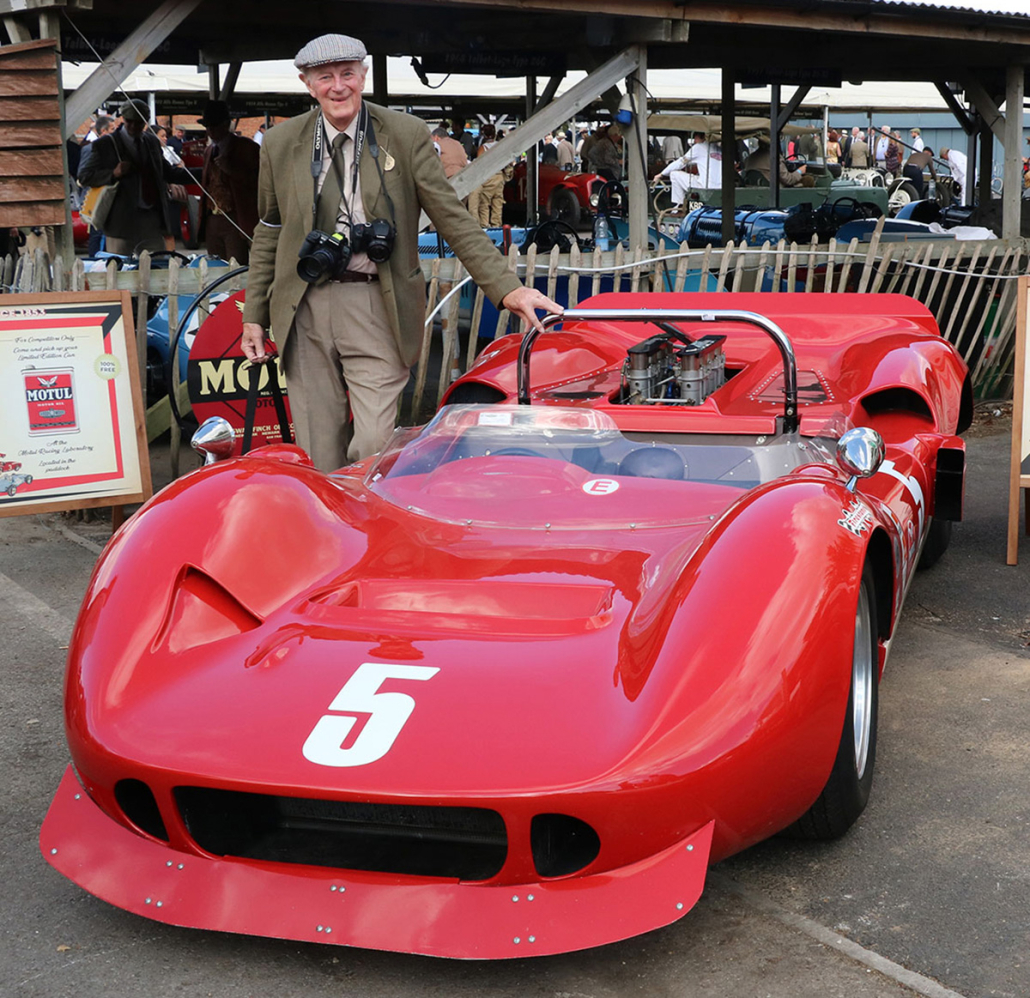
We were very saddened to hear of the passing of Guild member and renowned motoring artist Michael Turner earlier this month at the age of 91. We are grateful to fellow member Chris Mann for the following tribute.
Michael Turner was one of the Guild’s oldest and longest-serving active members, and also a founder member of The Guild of Aviation Artists, later serving as both chairman and president. He was an honorary fellow of the Guild of Motoring Artists.
Born on 14th March 1934 he spent his formative years in the London suburb of Harrow. Obsessed from an early age with all things aeronautical, he later extended his interest into cars and motor sport following a family holiday to the Isle of Man in 1947 where he saw his first motor race, the British Empire Trophy.
After art college and National Service with the Royal Electrical and Mechanical Engineers he was taken on as an illustrator by a London-based advertising agency. Michael was already an enthusiastic motorist, his first car being an Austin Seven special followed by a somewhat more sporty MG F-Type Magna.
As his finances improved Michael decided that he needed something faster and, combing through the then ubiquitous small ads of Motor Sport magazine, he came across an advertisement for an SS100 Jaguar. This he went to see “in a dusty mews lock-up in Bayswater”. A price of £350 was agreed and a £100 deposit paid, on the basis that the so-called dealer would rebuild the gearbox prior to Michael collecting the car the following week.
Unfortunately when Michael returned to pick up the SS100 both the dealer, and Michael’s money, had disappeared. A distraught Michael contacted the police who somehow managed to locate the car’s owner in Cardiff who generously agreed to sell the car to Michael for £250, the original price less the missing deposit, the only downside for Michael being the un-rebuilt gearbox.
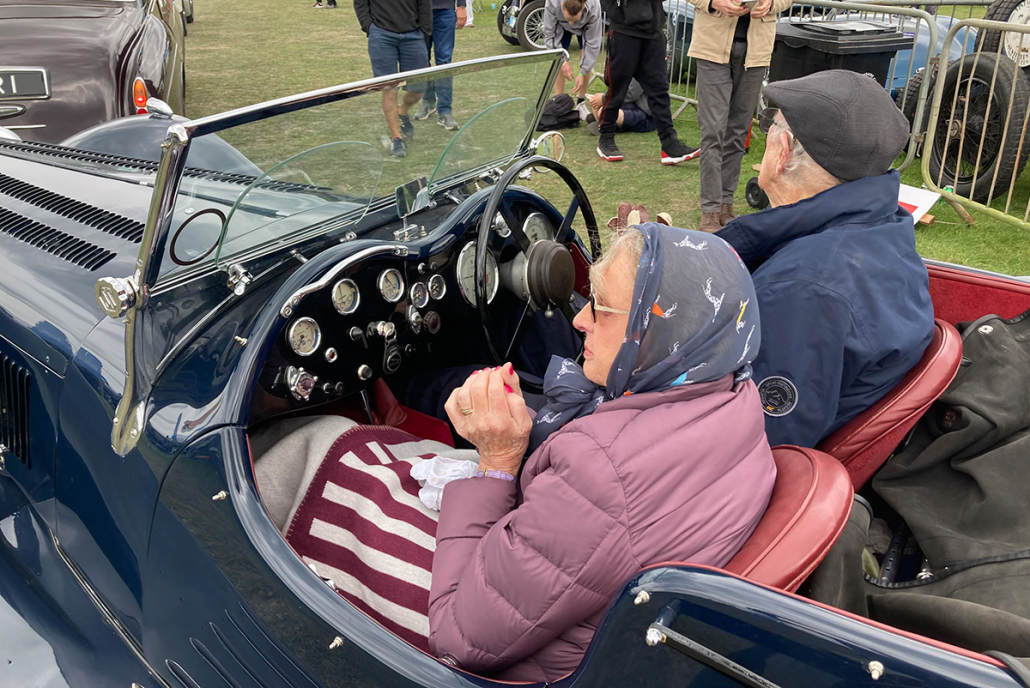
Michael used the SS100 (DTF 28) as his daily transport for the next few years, clocking up many miles and nearly as many adventures (including being rammed by a car driven by an American serviceman unfamiliar with driving on the left) “I was ejected from the driver’s door into the road and the rear wheel went over my foot”.
Michael also carried out his courting in the then cycle-winged Jaguar but much to his chagrin “girlfriends invariably took the mickey out of my SS with such quips as ‘is the bonnet strap there to keep the engine in’ or complaining about the effect of the wind in their hair”.
However one girl, Helen, seemed to genuinely enjoy going out in the SS100 and one day early in their courtship when the couple were driving from Wendover to Aylesbury, Michael decided to see whether the car would do the 100mph claimed. “I put my foot down and managed to get to an indicated 105mph when a line of stationary traffic loomed up ahead. After some scary moments I managed to pull up with about three car lengths to spare. Amazingly Helen remained calm and took it all for granted. I know then that I had found the right girl for me.”
As a young man, Michael harboured ambitions to go racing himself and, as the SS had previously been raced with some success, the temptation was strong. A trip to Silverstone, though, where he witnessed a massive accident at Becketts Corner caused Michael to rethink. “The SS was my daily driver so I couldn’t afford to risk damaging it. I loved driving but restricted myself to driving tests, gymkhanas, karting and the like.”
Meantime, despite having established himself as a successful illustrator in the world of advertising and publicity Michael was feeling increasingly constrained by his job so, in 1957, he took the plunge and went freelance, foregoing a regular salary cheque for the uncertain life of a self-employed artist.
Tight finances meant that the SS100 continued to provide his daily transport, regularly carrying artwork to London studios. On one occasion Michael recalled “a bus driver leaned from his cab, pointed to the SS and said ‘that’ll do half an hour in 20 minutes, mate”.
Michael and Helen married in 1960, going on to have three children, Graham, Alison and Suzie, so more practical everyday transport was now required, resulting in the purchase of a new Austin A40 Farina. The SS100 was retained however, despite a number of tempting offers including one from Jaguar’s PR director Andrew Whyte who told Michael that they were looking for an SS100 to add to their collection and asked if he would be willing to swap his car for a brand-new E-Type. “I thought long and hard and although I’d tried E-Types and loved them I couldn’t bring myself to part with my SS.”
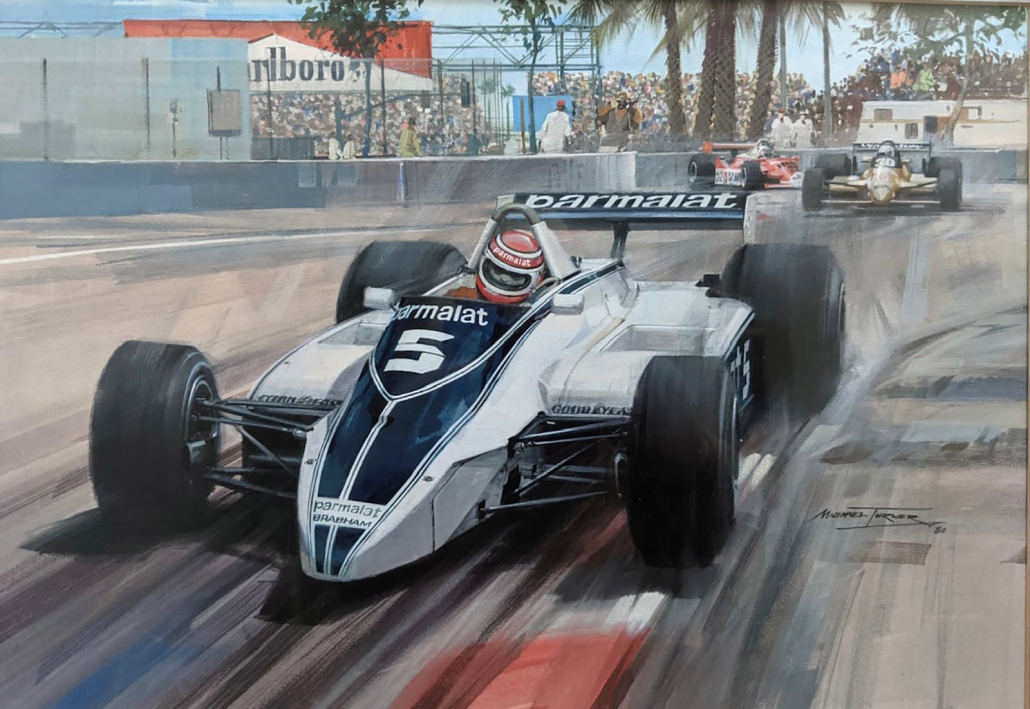
Michael and Helen established their own business, Studio 88, in 1963 in order to promote Michael’s artistic endeavours. By this time he had already built up a reputation as a highly-successful aviation and motoring artist, as well as being the go-to man for publicity posters for top-line motor racing events. By now, his paintings were gracing magazine covers, book jackets and the walls of the legendary Steering Wheel Club in Mayfair, then the mecca of the great and the good (and not so good) of motor racing.
As a result, Michael established close friendships with many of the top drivers and team owners of the time, including such legends as Stirling Moss, Jim Clark, Graham Hill, John Surtees and Jackie Stewart. Indeed, by the mid-1960s he had become as celebrated in his field as they in theirs.
As Michael later recalled “with fewer races on the Grand Prix calendar… drivers often had the time to spend the day after a Grand Prix relaxing and at Monaco, Cap Ferrat was a favoured secluded spot. After the 1965 event (for which Michael had produced the publicity maquette) I, along with Graham and Bette Hill, Jo Bonnier and Bruce and Pat McLaren were enjoying sunbathing and swimming from the stony beach.”
A couple of years earlier Bruce had set up his eponymous race car manufacturing company, calling upon Michael to design the fledgling manufacturer’s logo which, said Michael “was unkindly described by one journalist as a Kiwi being run over by a racing car”.
In the previous year, McLaren had produced its first Group 7 sports car, the M1A and “during the course of the morning at Cap Ferrat Bruce asked me if I would design a body for its successor (the M1B) due for completion in eight weeks time. On our return home Bruce provided me with a set of engineering blueprints… he approved a sketched proposal and, not being a stylist, I set to work to produce the necessary dimensional proportions on large sheets of graph paper spread on the studio floor.
“Tyler Alexander supervised the transposition of my drawings into metal and the semi-painted prototype was wheeled out of the Colnbrook factory the morning that it was to be airfreighted across the Atlantic for the opening race. Apart from the simplification or elimination of some of my styling embellishments… and the enlargement of some cooling vents for practical operational reasons, the result was surprisingly similar to the concept.”*
Promoting Michael’s work, along with marketing prints of many of his motor racing and aircraft paintings as well as the hugely popular F1 Christmas card sets, Studio 88 thrived. Some time later Michael’s son Graham, himself an artist of considerable repute, came on board and when Michael and Helen decided to take a step back, Graham and his wife Anita took over the business which they still run successfully to this day.
I got to know Michael about 25 years ago when my wife and I first went on one of the Guild’s then annual (and now much missed) European Classic Tours. He and Helen were regulars in their E-Type (Michael eventually succumbed to the lure of the E-Type but never parted from his beloved SS100) and proved great company. Both had a real gift for friendship, making everyone they spent time with feel special.
I later commissioned various paintings from Michael and these were invariably delivered on time and on budget, while Michael would frequently call up with an idea he had had for enhancing the image, even when it involved considerable additional work for him.
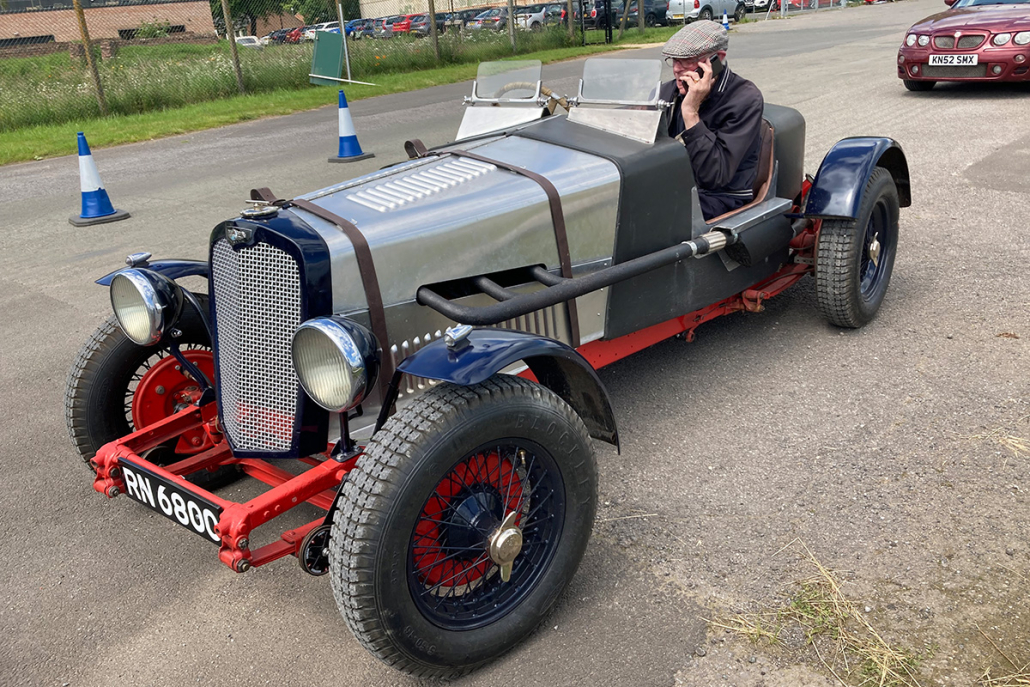
A few years ago we were both attending the Guild AGM at Bicester Heritage when his (relatively) modern MG ZT estate car failed to start after the meeting. Somehow the octogenarian Michael squeezed his lanky frame into my one-and-a-half seater 1936 Triumph Southern Cross race car, which had no doors and only minimal protection from the elements, and we headed back to Michael’s home in Chartridge, a journey which he claimed to have thoroughly enjoyed!
Michael’s aircraft studies were highly prized and he received regular commissions from the Royal Air Force. Some years ago, on a trip with Michael to a black-tie event at the RAF Club in Piccadilly I was amazed to see the sheer volume of wonderful Michael Turner paintings on the walls of this august establishment. A keen pilot, Michael flew his own De Havilland Chipmunk well into his eighties, only selling the plane when he lost his hangar space at RAF Halton.
Helen was a keen gardener who designed and laid out the beautiful gardens at their home of many years, Five Acres in Chartridge. She was enthusiastically aided and abetted in this by Michael who did much of the hard landscaping and, even up until a few weeks before his death, he could be found on the ride-on mower keeping the grass down.
After Helen’s passing, a loss which devastated Michael but which he bore with remarkable stoicism, we would take off on regular days out, visiting motor and aviation museums and assorted other venues we thought might be fun. Michael was always up for an adventure and I remember him being particularly taken with the Stanley Spence Gallery in Cookham and the Sir Henry Royce Foundation Archive in Paulerspury where we went only last summer, along with friend and fellow artist Dexter Brown, the visit followed by a much-enjoyed fry-up at the super Sausage Café on the A5!
Wherever we went, Michael would always have his digital camera at hand, snapping away at anything that took his interest or which he felt might be a useful reference to his next painting. Many a time he would ask me to stop at the roadside so he could take a photograph of a particularly interesting cloud formation that he felt might be worthy of painting.
Despite the loss of Helen and the medical challenges he faced in his latter years, Michael was unfailingly cheerful and good humoured, a gentleman in every sense and a great loss to his friends, his colleagues and, of course his family.
Following his father’s death Graham Turner said; “We will of course endeavour to keep his work available and his legacy alive in the years to come. That word ‘legacy’ keeps recurring in the incredible amount of wonderful messages and comments about my father and is something I’m very conscious of as I reflect on his life.”
Michael Turner was a one-off, a great artist and an even greater human being. He will be much missed and long remembered.
*McLaren quotes taken from The Motorsport Art of Michael Turner. Photos by Chris Mann