The Guild is saddened to report the passing of our member Alain de Cadenet on 2nd July at the age of 76, after a long battle with cancer.
Alain was a highly talented international racing driver and race team owner who found an equal passion and talent in the written word and behind the microphone. He took race victories in the World Championship for Makes and competed 14 times in the Le Mans 24 Hours between 1971 and 1986, seven of these behind the wheel of his own De Cadenet Lola. His best result was third overall in 1976, ahead of works entries from the likes of Porsche and BMW.
Retiring from motorsport he found a new passion as a TV presenter and writer, hosting numerous programmes for the Speed Channel, ESPN and others. He also experienced an early example of ‘going viral’ when during a piece to camera he was surprised by a very low-flying Spitfire (The clip can be viewed here).
Classic & Sports Car magazine, for whom Alain wrote a regular column, penned a tribute on social media, commenting; “Alain’s stories in person, on stage and in his regular columns were always hugely entertaining, reflecting a life lived at the sharp end – and often on a shoestring – during a golden era of motorsport.”
Guild member Andrew Marriott, writing for Motor Sport, described Alain as “quite simply a one-off, a man of intellect, humour and a brilliant communicator. That’s before you get into his cavalier career as a racing driver and later team owner … then add the fact that he flew a Supermarine Spitfire and, along with HM the Queen, owned the finest collection of King George postage stamps.”
In his book The British at Le Mans Guild member Ian Wagstaff asked “Can anyone at Le Mans have been more British than Alain de Cadenet?” and added that “however serious his intent, it was always important to Alain that Le Mans should be fun.”
Guild President Nick Mason raced at Le Mans in the same period as Alain and considered him a dear friend. Nick penned the following tribute;
“I had always perceived Alain as indestructible – particularly after a horrific motorcycle accident in the USA some years ago – so despite knowing that he had been ill, I was devastated to hear that he was gone. Truly a unique and wonderful personality, the world has to be a poorer place without him.
“What I will particularly miss is his overwhelming generosity of spirit. He shared his passion and deep knowledge of motor cars and motorsport with everyone he met.
“He was also a committed and talented racer himself, and was more than happy to become a mentor to any would-be competitor. I certainly benefited enormously from his support, as did my family. In 1979 he taught me the way round the Le Mans circuit, and in later years did the same for both my wife and daughters.
“It was there that I overheard DeCad in conversation with the Queen Mother, who was paying a brief visit to the circuit. She enquired what happened if it started to rain during the race? Alain put on his rarely used serious expression, and explained that one would immediately drive in to the pits and put a Frenchman in the car…”
Andrew Charman Photo by Jeff Bloxham
https://www.gomw.co.uk/wp-content/uploads/2022/09/2207deCadenet.jpeg12961600Frank Barnhousehttps://www.gomw.co.uk/wp-content/uploads/2022/09/Guild_Logo-300x300.jpegFrank Barnhouse2022-07-22 12:50:002022-09-21 14:09:13Alain de Cadenet 1945–2022
Leigh Robinson was a Cumbrian, born in the Lake District on 30 March 1948. In his early years he drove trucks for a living as a driver for BRS. Writing was clearly what motivated him though and he made his break into the local press in the 1970s, initially in the North of England, working on papers in Kendal and Blackpool, before moving further away from his roots on newspapers in Wimborne, Rugby and Newport. His break into motoring journalism came when the previous motoring correspondent of the Swindon Advertiser left to move to New Zealand. Leigh maintained his connection to publications in Swindon and Wiltshire, contributing regularly until his untimely death.
Before joining the Guild of Motoring Writers in 2013, Leigh had become a member of the Western Group of Motoring Writers and served as its chairman. This involved playing a key role in organising the annual Western Group PR Driving Day at Castle Combe Circuit, which was no mean feat at the time. Leigh remained an active member of the group until his death. He was due to take part in the Western Group’s inaugural Classic Run later this month with his partner Lisbeth Shore.
Two aspects of Leigh’s character have been mentioned repeatedly in the past week: his good humour and his gentlemanly behaviour. His was always a welcome presence. He will doubtless be remembered for much more besides, but these traits were unquestionably vital attributes in his long and successful career as a journalist.
Leigh’s wishes, stated many years ago were for no funeral or church service to be held. The Guild extends its sincere condolences to Lisbeth and daughter Julia.
Tony Gilroy, the man who saved Land Rover in the 1980s and turned the company into “the jewel in the crown” of the UK’s manufacturing sector by the early 1990s, has died peacefully at his Worcestershire home. He was 85.
A native of Cork, Tony kept a twinkle in his eye but had a reputation for toughness. In the boardroom he demonstrated a detailed knowledge of every aspect of the business, forensically identifying key issues and actions to resolve them.
Outside the boardroom he never sought the limelight. He also shunned the perks, such as a personal chauffeur, believing it was an unnecessary company cost. He was never as widely known as his contemporaries, Michael Edwardes, Harold Musgrove, Graham Day, and George Simpson.
But many who worked with him at a senior level, or for him on the shop floor, saw him as an unsung hero of the British motor industry.
His career started at Ford before taking on one of the toughest jobs in car industry – manufacturing director of the Longbridge factory. He managed to convince the workforce to accept the British Leyland rationalisation plan, and was instrumental in the dismissal of the Longbridge trade union convener, Derek ‘Red Robbo’ Robinson, who opposed it. Robinson was reported to have led 523 walk-outs in the 30 months before he was sacked in 1979.
Tony played a key part in the introduction of the mini Metro in 1980 and was promoted to managing director of Freight Rover, the van manufacturer. Given six months to turn the company around – or close it – Gilroy saved the business.
In 1983 he was appointed to the top job at Land Rover, and within months had identified its deficiencies and had developed a plan to make it successful. At the time 75 per cent of the company’s business was from sales of Land Rovers in Africa, the Middle East and Far East. But the collapse of the African economies, and the decline in oil revenues, meant that these markets could no longer afford to buy Land Rovers.
Tony recognised that Land Rover had to be more successful in mainland Europe and Australia. More importantly, Land Rover would have to sell vehicles in the world’s two largest car markets, North America and Japan (where Land Rovers were not sold at the time).
To succeed in North America the Range Rover had to be come a luxury vehicle with bigger engines, luxury leather interiors, and a host of other refinements. Looking to the future Tony identified changes in the world’s four-wheel-drive markets. New vehicles being developed by Japanese manufacturers (such as Toyota, Nissan and Mitsubishi) were in a growing new four-wheel-drive market segment between the agricultural Land Rovers and the luxury Range Rovers.
So Tony set up a special team that developed the Land Rover Discovery in a record time of 36 months — when most new vehicles took five years to plan and bring to market. Tony cleverly divided the development programme into elements that fell below his financial sign-off authority to avoid interference from British Leyland headquarters.
By using the existing Range Rover suspension and chassis — as well as raiding the parts bin from Austin Rover vehicles — Tony was able to develop the Discovery at a fraction of the cost that other manufacturers were incurring for their brand new cars.
The investment in improved Range Rovers, and the Discovery, was made possible by Gilroy’s plans to significantly reduce the company’s manufacturing cost base. He saved millions of pounds by closing more than a dozen satellite component-making plants and moving 3,500 people and their 22,000 manufacturing operations onto the main Solihull factory.
With Prime Minister Margaret Thatcher’s government anxious to sell off British Leyland, Land Rover was offered to General Motors who offered Tony a free hand with the company. But he had other plans, rejected the offer, and supported a successful ‘Keep Land Rover British’ campaign.
What Tony wanted was to acquire the company through a management buy-out. He very nearly succeeded but Thatcher stepped in personally to prevent the Rover Group being sold off piece-meal.
The management changes brought in by Graham Day (merging the Austin Rover Group board and the Land Rover Group board into one Rover Group board) left Tony in an impossible position. He left the company at the end of 1988, ironically before the public launch of his creation, the Discovery, in the autumn of 1989. Tony later headed up Perkins Engines, part of the North American-based Varity Group. When the company was merged to become LucasVarity Tony rose to chief operating officer worldwide working both in the United States and Europe.
When he retired he was able to spend his leisure time playing golf (he had been a member of Redditch Golf Club since 1974) and also took up shooting. Tony leaves a widow, Sandra, son Declan, daughters Claire and Fiona, and seven grandchildren. He was pre-deceased by son Aidan
His legacy in the UK was that he had saved Land Rover, developed one of the most commercially successful vehicles in British motoring history, and had laid the solid platform from which Land Rover became a successful worldwide brand.
As a former Land Rover employee commented: “If you had done your homework, you were OK. If not, you were dead.” It was true that Tony didn’t suffer fools gladly, but he enjoyed enormous respect from the people who worked for him. Many will remember Tony as a man who had a fierce exterior – but behind it there was a heart of Irish gold.
The word ‘gentleman’ is often applied to individuals we have lost but I can think of no better tribute to the wonderful, professional, kind and generous individual that was Tim Jackson.
Modern motor industry PR reflects little of what Tim stood for, concerned primarily with delivering a message whereas Tim always sought to be an individual with intense moral rectitude, warm and sincere humanity as well as a desire to seek to discover the nature and heart of every individual he encountered. He was always smartly turned out and never accepted that phrase ‘smart casual’ . . . , in Tim’s lexicon there was smart or there was casual!
I first came across Tim in his journalistic role with the Worksop Guardian – a welcoming and high-spirited motoring journalist in the halcyon days on the late 1970s. His bear-like figure loomed large over any and every gathering and his sense of humour, delicious love of a practical joke and an over-riding commitment to excellent writing and communication made him shine out in a period when there were many ‘wannabes’ and part-timers who seldom matched his energy and enthusiasm.
He persuaded me to leave the North and move South to join Renault just as the brand was making major waves with exciting product underlined with enormous presence in motorsport that Tim worked tirelessly to develop. He single-handedly made the Renault 5 Turbo Cup, Formula Renault, and then the Clio Cup and Renault BTCC entry, a mainstay of British motorsport – something that was later properly recognised by his role with the governing body. His love for high-octane motorsport led him to help so many talented individuals develop their careers in the sport and he also worked behind the scenes to maximise Renault’s involvement with the then all-conquering Williams F1 team – Mansell, Hill and Coulthard all benefitted individually and professionally from Tim’s unstinting support.
It was an intense pleasure to sit in his office with one of the Williams’ British pedallers discussing the current season and the potential of the latest product from the minds of Frank and his vital sidekick, Patrick Head. By that time Tim had quit smoking due to his diabetes so I benefitted for a massive supply of Camel cigarettes!
But most of all Tim was just such a pro. He used all of his personal charisma to entice me to move to the deep dark south but thereafter he taught me an inordinate amount about maintaining a balance between the demands of the company and the needs of the media. He tore me off more than one strip! But it was justified in every instance and I never made the same mistake twice. His guidance, friendship and attitude ensured that when I eventually left Renault I had the best grounding in the business I could have wished for.
Above: A youthful James May collects his award for Renault UK/Guild of Motoring Writers Journalist of the Year 2000 from then Renault UK public relations manager and later Friend of the Guild Tim Jackson.
When he married Ann, none of those who knew him were surprised! He had quietly but effectively sought her attention and even developed an affection for Preston North End FC to make sure his courtship delivered on his ambitions! And what a pair they made – with two wonderful children – Tim Junior and Helen – and a happy life away from the business with a lot of it spent cruising on their canal boa. Tim and Ann carved their own channel and lived the life they desired.
Tim was a true friend, a wonderful mentor and a magnificent professional. There are very few of his ilk stalking the corridors of the motor industry these days. The industry is poorer for it but those of us who knew him, spent time with him and worked with him are very much the richer for that experience.
So many of us will miss him but will be enlivened for having shared this world with him.
Stephen Kitson Friend of the Guild
https://www.gomw.co.uk/wp-content/uploads/2022/03/jackson_t.jpeg1022736Frank Barnhousehttps://www.gomw.co.uk/wp-content/uploads/2022/09/Guild_Logo-300x300.jpegFrank Barnhouse2022-03-15 12:42:002022-09-09 12:45:00Tim Jackson
For a racing driver Tony Dron was a remarkably good writer. And for a motoring journalist, he was an exceptional racer – so good, in fact that on one of the many occasions he won a round of the British Saloon Car Championship outright, his works-backed 2.0-litre Triumph Dolomite Sprint beating the massed ranks of more powerful 3.0-litre Ford Capris, the cover of that week’s Autosport carried the headline ‘DRONINGTON’. That year, 1977, he missed becoming overall series champion by one point…
Tony was always meant to be a racing driver. It all began, aged 12, with a 1932 Austin Seven in which he and brother Peter undertook time trials around the garden at the family home… when their mother had gone shopping.
Tony had plans – later abandoned – to turn the Seven into an aluminium-bodied special to compete in the 750 MC championship but his racing aspirations became rather more serious in 1968 when, aged 21, he bought a Titan Mk 4 Formula Ford competing against (and often beating) the likes of James Hunt.
Motor racing needs more than just talent, however, and a lack of funds forced him to consider another career. Innes Ireland, another racer-turned-writer, suggested he should try motoring journalism. He entered, and won, the Guild’s Sir William Lyons Award for aspiring journalists in 1968 and in 1971 joined the road test team of Motor, becoming the magazine’s sports editor a couple of years later.
Ironically, this new career meant greater chance to go racing. Hoping for exposure in the pages of the magazine, manufacturers and sponsors started offering him drives and he grabbed the opportunities with both hands.
He juggled both careers until the end of 1974 when he left Motor to take up the offer of a seat in a Capri 3000 in the ’75 BSCC… only for the drive to fall through at the last minute. Fate was smiling, however, as British Leyland was looking for a journalist to race a second Broadspeed Dolomite in the championship alongside Andy Rouse. As Dron told Octane in 2018: “It wasn’t difficult to be quite a bit quicker than the other journos, so I got the job.”
That year he won his class in the Tourist Trophy and came fifth overall with Rouse in the Spa 24 Hours. The following year he raced a works Alfa and in 1976 he returned to single seaters in a Unipart-backed Dolomite-engined March F3 car. The car wasn’t a great success, but it paved the way for a successful return to Dolly Sprints in 1977 and ’78. He also managed to win the Porsche 924 Challenge in ’78.
He continued to race but from 1979 to 1982 he also tried his hand as a car salesman working for Saab in London and later a Porsche dealership in Darlington. He once confessed that sitting alongside potential new owners trying out a Saab Turbo for the first time could be one of life’s more terrifying experiences . . .
The racing, meanwhile, stepped up a gear with a works drive at Le Mans in a Porsche 924 GTP in 1980 – 12th overall – and a class win in 1982 in a Porsche 934. Throughout the 1980s Tony was closely associated with AFN Porsche. He was always quick in their 928, often taking pole but invariably arrived at the first corner in fifth or sixth having lost out to 911 traction off the line. And ten laps seldom gave him enough time to get back to the front.
In 1982 he stopped selling cars and returned to the keyboard, first as features editor and then editor of Thoroughbred & Classic Cars (later just Classic Cars).
This move to the world of classic cars saw Tony turn his hand to track testing and racing significant historic cars, again with remarkable success. His ability to describe how the car behaved on track was as impressive as his racing record. Among many successful outings he won the Sussex Trophy at the Goodwood Revival three years running in a Ferrari 246S Dino and won the 1996 Eifel Klassik outright in a Ferrari 330 LMB.
In all, he reckoned to have won events in 24 makes and 44 models of cars, everything from Alfas and Allards to his own race and rally Zephyr. The actual number of wins was in the hundreds.
He left T&CC in 1993 but continued to write for the magazine for a while before becoming a contributor to Octane and the Daily Telegraph. He also wrote a few motoring books. He retired from racing in 2011 and from writing in 2018.
What those facts don’t reveal, however, is too much about the man. Yes, he was a seriously quick driver and a damn fine writer but there was much more to him, as has been proven by the flood of memories that have poured out on social media since his death from chronic obstructive pulmonary disease (COPD) was announced. Tony had picked up a lung infection on a trip to India when he was 19. This was followed by lung collapses in his 20s and was perhaps a contributory factor to his emphysema.
The comments show he was universally liked and admired – no mean feat in either business. Former colleague Rex Greenslade wrote: “He was such a good friend – mentor even – in my early Motor days, not just with regard to the writing and testing by also my nascent racing career. To have had the privilege, in 1979, of racing the Triumph Dolomite Sprint which he had developed to such a high level is something I will always treasure.”
Our own Sue Baker wrote: “He was one of the greats. Always entertaining company, and I even forgave him for beating me to the Sir William Lyons Award way back. Such a talented driver and writer.”
Tony was Malcolm McKay’s boss at Classic Cars. “(He) taught me so much – about life and enjoying it as well as about writing and editing magazines. And especially about driving. Sitting alongside him as we slid to a major award on the very slippery Longleat Stages in his Ford Zephyr as he controlled it from lock to massive lock while holding the column shift in gear AND flicking the overdrive switch on the dash was a masterclass – and one of many.”
Tony was something of a hero – and mentor – to me, too, and gave me aspirations to become a motoring journalist. I first met him in the early 1970s when I was a cub reporter on a South London newspaper, and I discovered he lived locally. He soon became a regular source of stories for the sports pages, tales of his exploits in Escorts, Dolomites and the F3 March providing a welcome relief from the acres of football stuff that usually graced the back pages.
I remember the first time I interviewed him in his bachelor flat in Blackheath – he was funny, charming, encouraging and helpful. He knew the value of a good story, all of which helped a slightly nervous, star-struck – I was an avid reader of Motor – wet-behind-the-ears youngster starting out in his chosen career.
People mattered to Tony, and he had an amazing knack of making you feel important, regardless of whether you were or not. As well as giving me stories, he was generous with his time and his guidance. He took me under his wing and introduced me to other members of the South London motorsport mafia, including an up-and-coming young Modsport driver called Jonathan Palmer. The fact that Tony’s life seemed impossibly glamorous – his co-driver/navigator on the 1975 Avon Tour of Britain was a Penthouse Pet called Madeleine LeMauviel, for example – also helped.
When I became editor of Classic and Sports Car, he was my opposite number on Classic Cars. Appreciating his skill behind the wheel and the keyboard, not to mention his encyclopaedic knowledge of the subject, I knew I was something of a fraud.
The Guild would like to offer its sincere condolences to Tony’s family and friends, notably his brother Peter, daughters Amy and Katy and son Will, and of course his wife Charis Whitcombe.
The family has established an on-line memorial book – www.remembr.com/tony.dron – where friends and fans can post their memories of a remarkable man.
Matthew Carter Photos: Jeff Bloxham
A message from Tony Dron’s family
Tony Dron died last night (Tuesday, November 16) aged 75 from medical complications relating to his chronic obstructive pulmonary disease (COPD).
Tony was more than an excellent racing driver, author and motoring journalist, he was a beloved husband, father and grandfather, and it’s impossible to express how much he will be missed by us all.
We thank everybody for their messages of condolence – they are greatly appreciated. Due to the large number of them we have created a page at remembr.com/tony.dron and ask that memories of Tony are posted there while we make the necessary arrangements for the funeral.
We will also be looking into the possibility of a memorial service and will share details of that should it come to fruition.
When the late Harry Mundy finally gave in to the offers to join Jaguar in 1968, Geoff Howard took over as technical editor at Autocar. He was always an enthusiastic road tester and organised the journal’s team of testers, in addition to his major role in covering and describing the latest products and developments from the motor industry.
Geoff had joined the staff of Autocar in 1962 with the declared aim of guiding readers to be more discerning in the choice of cars to buy. He had achieved an Honours BSc in mechanical engineering at Imperial College, London, and started his engineering career working for de Havilland.
After six years as Autocar’s technical editor he left the journal in 1974 to join Ford as chief press officer (cars), later moving to Ford of Europe as manager of product and technical information.
In 1981, Geoff left Ford and set up as a freelance writer specialising in cars and engineering, and was one of the first to invest in a Commodore computer, known in those early days as a ‘word processor’.
He was always very knowledgeable and interested in all matters relating to computers and even built his own computer.
A keen gardener, he liked to have an immaculate garden at his home near Cambridge, with ponds exactly level and lawns beautifully manicured.
This has been a bad 12 months for Geoff, as he began to lose balance control and could not walk unaided, as well having to be fed through tubes because any solid food went into his lungs causing pneumonia which he suffered three times in 2020. He died in his sleep just after his 84th birthday. The Guild offers sympathy to his widow Jane, and their two sons, Justin and Alexander.
Stuart Bladon
https://www.gomw.co.uk/wp-content/uploads/2022/09/howard_geoffrey_peter.jpeg750540Frank Barnhousehttps://www.gomw.co.uk/wp-content/uploads/2022/09/Guild_Logo-300x300.jpegFrank Barnhouse2021-11-09 12:25:002022-09-21 14:10:40Geoffrey Peter Howard 1937–2021
The Guild was deeply saddened to learn of the death of William Kimberley last week after a three-year battle with cancer.
William began his long career as an automotive writer publishing The Kimberley Grand Prix Guides, and later joined Motor Sport magazine.
With a fantastic understanding of technical journalism, he spent 10 years as editor of Automotive Engineer, and joined Race Tech magazine in 2006. He later launched Historic Racing & Technology magazine and also founded the World Motorsport Symposium, alongside his wife and Kimberley Media Group publisher Soheila Kimberley.
Most recently, he was editor-in-chief of Race Tech, and won a number of journalism awards during his career.
William was also a prolific author, having written The Ford that Beat Ferrari in 1985, as well as a number of books on the Triumph TR6, TR7 and TR8, plus Hot Hatchbacks. Motorsport titles included Learn & Compete: a Primer for Formula SAE.
William joined the Guild in 1984, and was always a strong supporter of our role as a voice for automotive journalists and photographers, as well as participating in events.
He loved bringing his classic Bentley to Guild events – it was his first car and he had owned it since the age of 17.
Many members have already expressed their sadness at William’s passing, and he will be missed by all of us.
William’s funeral service will be held St. Marylebone crematorium in East Finchley at 1pm on 8 November. If you’re unable to attend, but if you wish to join his ceremony, watch live on the web link below.
If you are an enthusiast as well as a journalist the chances are that you will find Graham Robson on your bookshelf. In 50 years as a professional author, he produced nearly 170 books on motoring subjects, ranging from marque histories to biographies of designers and engineers and stories of rallies and rally people.
He was, without doubt, the Guild’s most prolific author and his work won numerous awards in Britain and America, including the Montagu Trophy in 2004.
Graham died peacefully on 5 August at home in Dorset, where he had seemed to be recovering slowly from a fall in May which fractured his hip and had required a long spell in hospital. He was 85 years old.
A Yorkshireman with a blunt manner that some found abrasive, he was modest about his own achievements and intensely loyal to his friends and colleagues. His writing was always crisp and clear and without pretension and his research was thorough, aided by his own extensive library of books and journals.
He graduated from Oxford in 1957 and joined Jaguar as a trainee design engineer. Involved in rallying at a club level, he was given the opportunity to co-drive for the Rootes team of Sunbeams in international events and that led to a full-time job as manager of the Standard-Triumph motorsport operation, rallying Triumph TR4s and Spitfires and racing at Le Mans. Later, in 1965, he was to co-drive with Roger Clark in a Lotus-Cortina to win the Welsh International Rally.
By then, Graham had entered journalism, joining the Autocar Midland office. Over the next five years he worked on all aspects of the magazine and his technical assessments of cars brought him to the attention of Chrysler UK who made him chief engineer of product proving. A short spell at seat-belt maker Kangol followed, before he returned to journalism as a freelance with a plan to write books that would appeal to the growing classic car movement.
The first of these was, logically, The Story of Triumph Sports Cars for Motor Racing Publications in 1973. Graham was quickly established as the complete professional: his editors (of which I was one) appreciated that his copy was always accurate, well presented, to length and on time. He had a ferocious work ethic – all day, every day, and if he allowed himself some time off, he prided himself on ‘always making up for it’. He never retired and was still working on a major project at the time of the accident.
Graham’s continuous stream of books was to make him well known in classic car circles and he was much sought-after as a guest of marque clubs and as a commentator at concours and historic car events, including the Goodwood Festival of Speed.
His wife Pam died seven years ago in a care home, after a long retreat into Alzheimer’s disease. He is survived by his sons Hamish and Jonathan to whom we send all sympathy.
Ray Hutton
Graham’s funeral will be held at Weymouth Crematorium, at 1pm on Monday, 6 September. There will be a remote web cam service facility for those unable to make the journey. For details contact Jonathan Robson at jonathan.e.robson@gmail.com.
Johnny Dumfries (John Colum Crichton-Stuart, 7th Marquess of Bute), Honorary member of the Guild of Motoring Writers (Photo: Jeff Bloxham)
His biggest success came in the 1988 Le Mans 24 Hours, when he shared the winning Jaguar with Jan Lammers and Andy Wallace – the Coventry marque’s first outright victory in the event since 1957.
Two years earlier there had been a single season as a grand prix driver, alongside Ayrton Senna at Lotus team-mate. Such are the facts the wider world knows about the career of Johnny Dumfries, who has died at the age of 62, but such simple statistics do him a disservice.
Johnny Dumfries’s ascent to the motor racing summit owed nothing to his aristocratic background, something he kept well hidden when he was racing in the cut and thrust of Formula Ford during the early 1980s. It was the result of hard graft – working as van driver, painter & decorator, among other things – and natural competitive flair.
By 1983 he had shown sufficient promise to graduate to the British F3 Championship, running a one-year-old Ralt on a shoestring budget with the small AMR team. He obtained a number of strong results, though he failed to finish on the day that really raised his profile.
At Silverstone in June, there was a race counting towards both the British and European championships. Dumfries qualified third, behind UK title protagonists Martin Brundle and Ayrton Senna, and made a better start than the Brazilian to run second initially. His hopes of a podium result detonated along with his engine, but a marker had been laid.
That winter, BP recruited him to drive for its F3 team in 1984 and, at the wheel of a Ralt run by David Price, Dumfries won 10 of the 17 races to emerge as runaway champion. And even though he missed a couple of races due to date clashes, he also finished second in the European series, only a few points behind winner Ivan Capelli.
Despite this stellar campaign, a shortage of sponsorship compromised his chances of graduating to the FIA F3000 Championship, grand prix racing’s unofficial finishing school. He found support to do the first five races in an Onyx March, finishing sixth at Vallelunga, and later did a couple of events in an uncompetitive Lola, but it was a frustrating campaign.
Even so, he was offered an F1 chance with Lotus the following season. Derek Warwick was expected to get the drive, but team leader Ayrton Senna didn’t want an experienced F1 driver in the second car and Dumfries seized the opportunity that came his way.
His season was hindered by unreliability – and his clear role as the team’s number two – but he managed a couple of points finishes, though by then he already knew he would not be staying beyond the season’s end. Lotus had done an engine deal with Honda, whose preferred driver Satoru Nakajima came as part of the package.
Johnny Dumfries (left) with Jaguar teammate Jan Lammers (Photo: Jaguar Daimler Heritage Trust)
With no fresh F1 opportunities available, Dumfries switched to endurance racing – and shared second place with Mauro Baldi in the Brands Hatch 1000 Kms, the duo’s Porsche 962 splitting the Tom Walkinshaw-run works Jaguars. Afterwards, Walkinshaw suggested Dumfries should give him a call – and that led to the offer of a full-time drive, the highlight of which would be that Le Mans victory in June 1988.
Later that year, however, a mistake on the opening lap at the Nürburgring persuaded Walkinshaw not to retain his fellow Scot the following season. Dumfries switched to Toyota’s sports car programme for the next two years, but with no deal on the table for 1991 he decided to hang up his helmet and start a fresh life helping to manage the family estate.
He wouldn’t race again.
I’ll remember him as a grounded and friendly, someone whose background I would never have guessed as we sat chatting over egg and chips in the ramshackle café that once sat to the outside of Silverstone’s Woodcote Corner. He won’t ever be listed as one of the all-time greats, but his 1984 season underlined significant potential that would remain ever unfulfilled.
He was a good bloke, taken far too soon.
Simon Arron
The 1988 Le Mans-winning team of (left to right) Andy Wallace, Jan Lammers and Johnny Dumfries reunited with their iconic XJR-9 car in 2012. (Photo: JD Classics)
The Guild of Motoring writers was saddened to learn of the death of member and motorsport commentary legend Murray Walker on Saturday.
Graeme Murray Walker, was born in Birmingham in October 1923, and saw service in the Second World War as a tank commander after graduating from the Royal Military College, Sandhurst, and on leaving the army at the end of the war had achieved the rank of captain.
Motorsport was in his blood, with his father Graham having been competition manager for Sunbeam, and later sales and competition director for Rudge-Whitworth.
Murray competed in motorcycle racing and trials, and his first public racing commentary was in 1948 at the Shelsley Walsh Hillclimb, while a year later he commentated on the British Grand Prix for the BBC. Murray and Graham commentated together for the BBC on many motorsports events, and after the death of his father in 1962, Murray became the BBC’s lead motorcycle race commentator.
While he indulged his love of motorsports in commentary, he also carved out a successful career as an advertising executive. It wasn’t until the late 1970s that he became the BBC’s full-time Formula One commentator in a career that continued until his retirement in 2001, including F1’s switch from the BBC to ITV on UK television.
During his television career, he also became a memorable part of the BBC’s coverage of the British Touring Car Championship, and brought his immense professionalism and insight to the domestic series.
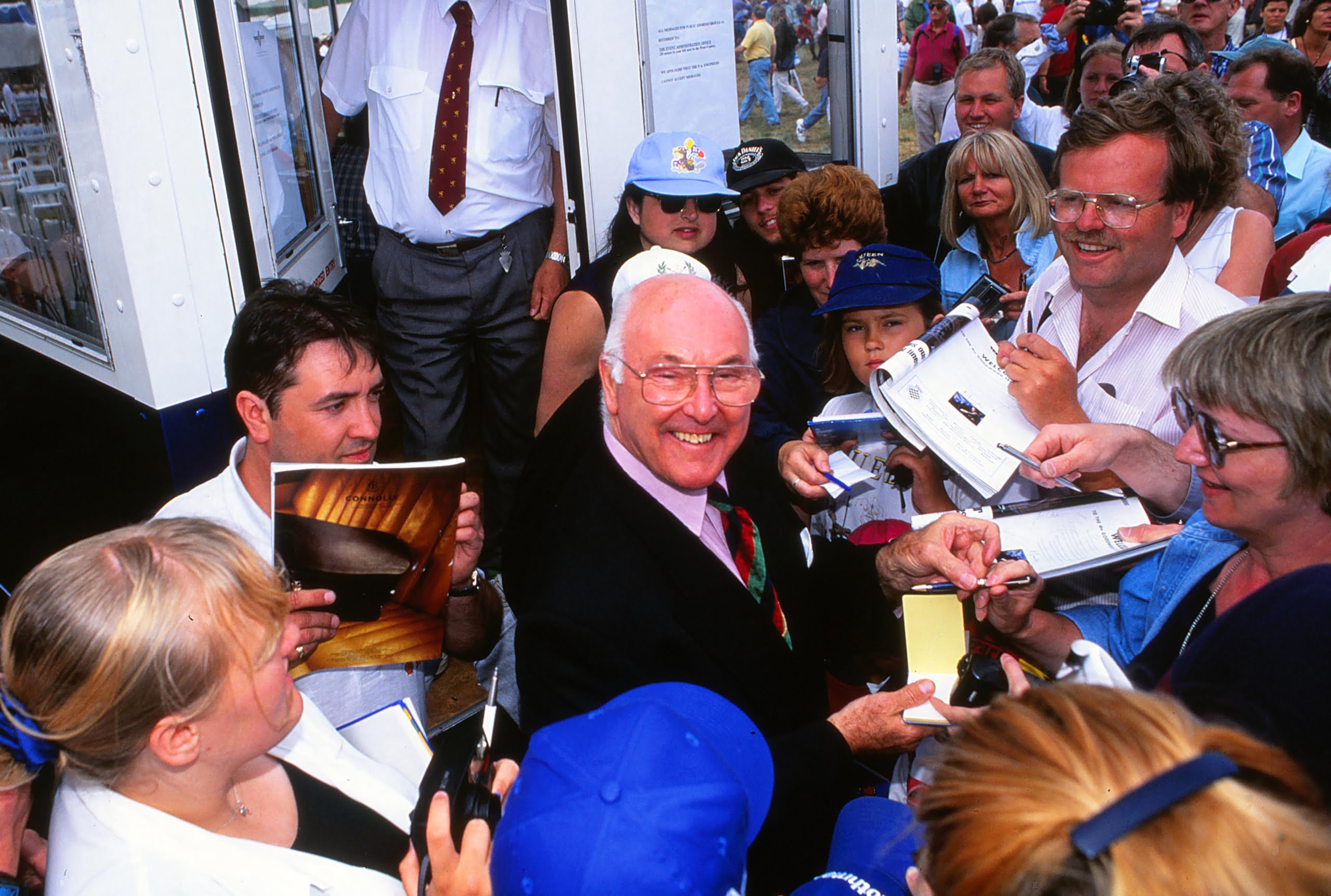
Murray joined the Guild of Motoring Writers in 1990, at the height of his success as one of the most recognisable voices in sports commentary, and with a following across the English-speaking world of motor racing enthusiasts.
Formula One writer and Guild member Maurice Hamilton leads our tributes to Murray.
“Murray Walker’s company at the races was like being with your favourite uncle. The paddock seemed to be complete when he appeared; a stocky figure who was welcome everywhere thanks to an easy-going manner and a natural desire to chat to one and all, be it mechanic, team principal or top driver.
“Unfailingly polite and gentle, Murray did not conform to the thrusting image of the modern sports reporter; a characteristic that was seen by the motor racing majority as an asset rather than a failing. Having been commentating since 1948, Walker was ‘Old School’, and he saw no reason to change. In fact, he couldn’t, even if he had tried.
“Murray was driven by incredible enthusiasm, his deep love of the sport being instantly transmitted through a high-octane delivery informed by meticulous research and copious notes. If anything, he knew too much. A bursting desire to share all his thoughts with viewers led to tongue-tied moments for which, initially, he was criticised. Over time, however, classics such as “He’s in the pits and I’m stopping my start-watch” would form a list of ‘Murrayisms’ that generated increasing affection before his retirement as a full-time commentator in 2001.
“Despite his vast experience and global reputation (Walker had a huge fan club in Australia), Murray remained self-effacing and relentlessly professional. As a summariser on F1 for BBC Radio 5 Live in 2007, I was to discover this at first hand when Walker was persuaded to make a brief comeback as a stand-in when our lead commentator was forced to miss the German Grand Prix.
“There were no airs or graces; no prepared excuses for being rusty or out of touch. Murray arrived early and insisted on being a part of our team at every turn, both business and social. He never came close to playing the ‘Well, in my experience….’ or, ‘I think we should do it this way’ cards you might expect. If anything, he was mildly apprehensive. But it didn’t take long for the adrenalin to kick in. In fact, he couldn’t wait to get going at the start of qualifying.
“The British Open was on at the same time and 5 Live Sport that Saturday afternoon was being presented by John Inverdale from Carnoustie. Inverdale began the hand-over to the Nürburgring with an effusive welcome for a broadcasting icon who was returning to his radio roots.
“Meanwhile, the cars were leaving the pits and I could see, the longer this gushing introduction continued, the more agitated Walker was becoming. When the big moment finally arrived, rather than thank Inverdale for his very kind words and describe how much going back to BBC Radio genuinely meant to him, Murray, at peak revs, launched straight into: ‘Qualifying HAS BE-GUN!’ And we were off!
“It was to be a truly memorable weekend and a privilege to sit alongside such a legend. Before the start, our producer resurrected ‘The Chain’. When the familiar beat hit the airwaves, the hairs on many a neck stood up. It was the prelude to hearing an equally evocative voice motor sport fans had taken to their hearts – and where it will forever remain.”
Guild of Motoring Writers president Nick Mason writes: “Murray Walker established himself as the definitive voice of Formula One for generations of enthusiasts, covering the sport for around half a century. Throughout he constantly remained an ardent fan, rather than a know-it-all.
“Clive James’s description of him as a broadcaster sounding as though ‘his trousers were on fire’ sums up both his style, but also indicates one of the many reasons he was held in such high regard and affection.
“He was of course a consummate team player, and his partnerships with James Hunt, and later Martin Brundle, provided perhaps the very best commentaries ever provided for any sporting contests.
“His motor sport enthusiasm extended well outside the Formula One circus, and his own experiences of motorcycle racing gave him a unique insight and sympathy for the less glamorous elements of the sport.
“Murray will be sorely missed not only by the Formula One paddock but a global audience of his fans.”
Pic by Samantha Cook Photography 05March15. Opening of two motor sport displays; Grand Prix Greats and Road, Race and Rally, collectively known as A Chequered History. VIP guests Murray Walker and Sir Stirling Moss officially open the new exhibitions.Murray Walker and Sir Stirling Moss opening the motorsport display at Beaulieu.
F1 writer and broadcaster Simon Taylor, also a Guild member, writes: “Murray Walker was a one-off. He brought a vast new audience to TV’s coverage of Formula One, an audience that adored him. He was a modest man, and he could never quite understand why, when he appeared in any English-language country that took his commentaries, he was mobbed more than most of the drivers.
“He was a wonderful communicator, because when he described a race his enthusiasm was completely genuine, and never simulated. He really was excited by what he was talking about, even after he had been describing motorsport of one sort or another for over 60 years. In his torrent of words there was drama, there was atmosphere, and there was humour, and underlying that was a huge amount of hard work.
“At every Grand Prix he would walk the track, carefully annotating his own circuit diagram. He would talk to everyone in the paddock, and because he was such an amiable, courteous man everyone – from the world champions and the team bosses down to the mechanics – was happy to talk to him. His friendships with the likes of Nigel Mansell and Damon Hill were well-known, but there was a barely a driver in the paddock who didn’t greet him simply as ‘Murray’.
“It’s a shame, but no surprise, that many of the avalanche of obituaries in the general media have majored on his much-repeated, and often very funny, ‘Murrayisms’. But those were very rarely errors of fact. Usually they were mistakes of expression in the excited torrent of words as he rushed to describe what he saw. After all, it would be strange if, in 60 years and probably billions of words, there wasn’t the odd blooper. And Murray took it all in good part – which is why he called his autobiography Unless I’m Very Much Mistaken.
“Prodigious energy, careful research, an unbreakable work ethic and a style that was entirely unique: all that made Murray a very great commentator. And friendliness, honesty, good manners and a feet-on-the-ground common sense: all that made Murray a delightful human being.”
Guild member David Tremayne, of Grand Prix+, writes: “Everyone thought they could do a better job of commentary when Murray Walker made one of his famed Murrayisms, which became part of racing’s rich lexicon.
“Who could forget pearls such as: ‘Unless I’m very much mistaken – which I am!’ ‘This would have been Senna’s third win a row, if he’d won the two before.’ Or ‘Mansell can see him in his earphone.’?
“They made people laugh, but they also endeared him to his audience. And such gaffes were not the product of ignorance, but his adrenaline-fuelled excitement. And behind them, few ever prepared so carefully and professionally for their job, nor had such an encyclopaedic knowledge of their sport.
“His ‘pants on fire’ style gave everyone a sense of the true thrill of Formula 1, and generated excitement even when there was none. And he was instrumental in helping the sport’s tremendous growth from the late Seventies right through to the turn of the century.
“He genuinely loved it, and saw his role as being to convey that love to viewers while filling them on what was happening on track and behind the scenes.
“He was an innately kind man, and could laugh at himself. And he was a toughie. At the age of 89 in 2013 he recovered from a fractured pelvis after a tumble, and saw off lymphatic cancer.
“In ‘resting’ mode he was super-friendly, wholly approachable, someone I was very proud to call a friend. A wonderful character, and a genuine legend, he probably hadn’t the slightest idea that he was also one of those rarest of men, whose passionate love for the sport was reciprocated thoroughly by everyone within it.”
Honorary Guild member the Duke of Richmond and Gordon writes: “Murray Walker was a dear friend of Goodwood, who played an important part in our events over the years, including in the early days of the Festival of Speed and the Goodwood Revival.
“Murray’s final Goodwood commentary was on the inaugural Settrington Cup at the 2012 Revival, when he brought all his trademark enthusiasm, professionalism and meticulous preparation to bear, despite the fact it was ‘only’ a pedal car race.
“His love of the sport never wavered, and his ability to convey that unbridled joy to an audience meant he did more than perhaps anyone else to promote motor racing globally. We will miss him terribly, and our thoughts are with his family at this difficult time.”
He added that Murray also umpired the Goodwood Revival cricket match – a fond memory for the Duke and his family.
From the Royal Automobile Club members’ section:
“When all the tributes have been paid and the anecdotes and Murraryisms lovingly shared, members of the Club will be delighted to know that, uniquely, they are able to reflect on the life and times of friend and fellow Club member Murray Walker in a wonderfully appropriate place: The Murray Walker Television Room.
“Located in Pall Mall and opened by Murray in 2019, the room is only the second place in Pall Mall to bear the name of a racing personality, the other being the Segrave Room. The significance of this was not lost on Murray who said, “I find it very hard to put into words just what it means to me. I was, and remain, completely bowled over.”
“His delight was captured in a video interview presented by Simon Arron of Motorsport magazine, assisted by racing commentator Alan Hyde, recorded when the Television Room was opened. Its occasion marked what was almost Murray’s 60th anniversary as a member of the Club, a membership which, as he explains in the film, was very dear to him since his father, Graham Walker, was also once a member.
“During this fascinating and enjoyable film, Murray interrupts his recollections of life at the microphone to discuss the memorabilia arranged around the Television Room. Personal highlights include the rear wing given to him on his visit to McLaren and signed by the staff and team, and an original brick from the Indianapolis Motor Speedway, presented to him in 2001.
“Reflecting on his career towards the end of the film, Murray says, in characteristically modest fashion: ‘Those who can, do and those who can’t, talk about it.’ As we remember Murray Walker’s hugely compelling and enjoyable contribution to racing, we can only be thankful that his huge talent found its outlet in speech.”
F1 aces Derek Warwick, Sir Jackie Stewart and Martin Brundle with Murray Walker at the opening of the Murray Walker Television Room at the Royal Automobile Club.
It’s possible to hear an interview with Murray by Tom Clarkson in the following podcast:
REVISITED: Murray Walker – An incredible life, in his own words F1: Beyond The Grid
To millions of F1 fans around the world, Murray Walker was much more than an F1 commentator. He was the man that brought their passion to life, with his unmistakable voice sound-tracking – and enhancing – some of the greatest moments in the sport’s history. As the world mourns his sad passing, at the age of 97, we bring you Tom’s conversation with Murray from early 2019, as he looked back on his incredible life story, from the battlefields of World War Two to F1 commentary boxes across the globe.